If you’ve spent five minutes on fitness TikTok lately, you’ve seen the debate: mini stepper or walking pad? Both promise the same thing — cardio that fits in a closet. But almost everything written about this comparison so far is either a brand blog pushing its own product or a TikTok clip with no real data behind it.
I’m Ammad, a fifth-year medical student who also runs this site, and I wanted an actual answer — one that accounts for joint mechanics, real calorie math, and the thing nobody talks about: whether your downstairs neighbor is going to file a noise complaint. Here’s what the evidence actually says.
What’s the Actual Difference Between a Mini Stepper and a Walking Pad?
A mini stepper is two hydraulic pedals that move up and down, simulating stair climbing. You stay in one spot, and your legs do the work against resistance. A walking pad is a low-profile treadmill — a moving belt you walk on, usually between 0.5 and 4 mph.
The core difference isn’t just the movement pattern, it’s the muscle demand. A stepper is a vertical, resistance-loaded motion that leans on your quads, glutes, and calves. A walking pad is a horizontal, gait-based motion that recruits your whole kinetic chain — the same way outdoor walking does, just indoors. One isn’t “better” in the abstract; they load your body differently, and that difference is what actually decides which one fits your apartment, your joints, and your schedule.
Is a Mini Stepper or a Walking Pad Better for Weight Loss?
Neither wins outright — it depends on which one you’ll actually use for 30+ minutes, most days of the week, because that’s what weight loss is downstream of.
A 30-minute mini stepper session burns roughly 200–400 calories depending on bodyweight and resistance. A brisk 30-minute walking pad session burns a comparable 150–200 calories, but the walking pad’s real advantage is that people tend to use it for much longer stretches — an hour or more while working — because it doesn’t demand full attention the way stepping does.
So the honest framing is: stepper wins on calories-per-minute, walking pad wins on calories-per-day, because it’s easier to sustain in the background of your life. If you’re someone who will genuinely dedicate focused workout time, the stepper is more time-efficient. If your realistic use case is “on while I work,” the walking pad will rack up more total volume.
Which Is Easier on Your Knees and Joints?
This is where most of the existing comparison articles get vague, so let’s be specific about the mechanics.
A mini stepper keeps your foot in constant contact with the pedal — there’s no landing impact, which physical therapists note makes it genuinely low-impact in the ground-reaction-force sense. But the tradeoff is that your knee is doing continuous flexion-extension under resistance, in a shortened range of motion, which can aggravate anterior knee pain (patellofemoral pain) if your tracking or quad balance is already off. If you have healthy knees, this isn’t a concern. If you have a history of patellofemoral pain or are early in recovery from a knee injury, the constant loaded flexion is worth discussing with a physical therapist before you commit to daily sessions.
A walking pad reproduces your natural gait cycle, which distributes load the way your joints are built to handle — but it’s not zero-impact. Each step still involves a landing phase, just a much gentler one than running or walking on concrete outdoors, because the belt and deck absorb some of that shock.
Practical takeaway: if you have no joint history, both are safe low-impact options. If you have knee-specific issues, a walking pad’s natural gait pattern is generally the gentler starting point; if you have hip or lower-back sensitivity instead, the stepper’s stationary, upright position can actually be easier than the repetitive forward-loading of walking.
Which One Is Actually Quieter for Apartments?
This is the question almost nobody has answered properly, and it’s the one that matters most if you live above someone.
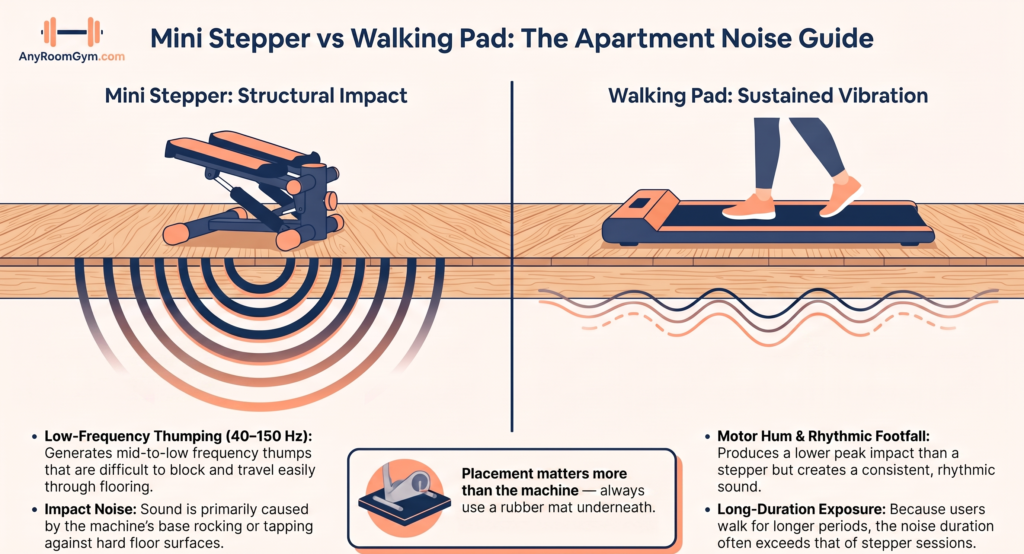
Mini steppers are inherently more likely to transmit impact noise through flooring — even though the stepping motion itself is soft, the machine’s base can rock or tap against the floor with each rep, especially on hydraulic models with worn cushioning. That’s a mid-to-low frequency thump, the exact frequency range (40–150 Hz) that’s hardest to block and most noticeable to a downstairs neighbor, similar to footstep noise.
Walking pads are generally quieter in terms of motor noise, but a heavier walker or a fast pace on a cheap belt can produce a rhythmic thudding that’s arguably worse over a 45-minute session than 15 minutes on a stepper, purely because of duration.
Neither is silent, and the honest answer is that placement matters more than the machine. A stepper or walking pad placed directly on hardwood or tile with no mat underneath will transmit noise regardless of which one you buy. A thick rubber mat under either machine cuts impact noise significantly.
If apartment noise is your actual constraint (not just a side worry), run your specific setup — floor type, machine, workout time — through our Apartment Gym Noise Checker before you buy anything. It’ll give you a much more useful answer than “steppers are quieter” or “walking pads are quieter,” because the honest answer is: it depends on your floor.
Can You Use One While Working at a Desk?
Walking pad: yes, comfortably, at slow speeds (1–2 mph), which is exactly why it’s become the default WFH cardio tool. You can type, take calls, and hold a normal upright posture while walking.
Mini stepper: technically yes, but practically no for focused work. The vertical stepping motion moves your torso and shifts your center of gravity with every rep, which makes typing accurately or speaking clearly on a call much harder. Steppers work better as a dedicated 15–20 minute session where you’re not multitasking, sometimes with the included resistance bands for an upper-body add-on.
If your actual goal is “more movement while I work,” the walking pad is the better tool for that specific job. If your goal is “a fast, focused cardio session I can do in a corner,” the stepper wins on time efficiency.
How Much Space Does Each One Actually Need?
A mini stepper’s footprint is genuinely tiny — most are around 15–20 inches wide and can slide under a bed, desk, or into a closet corner when not in use. A walking pad needs more floor space while you’re actively using it (most are 4–5 feet long), though quality folding models compress down to a thin slab you can store vertically against a wall or under a bed frame.
If your apartment has almost no dedicated floor space at all — a studio, a shared room — the stepper’s smaller working footprint is the more realistic fit. If you have even a narrow strip of open floor (near a window, in a hallway), a folding walking pad is manageable and arguably more versatile.
Which Should You Buy If You Can Only Afford One?
Based on the mechanics above, here’s the actual decision logic rather than a generic “it depends”:
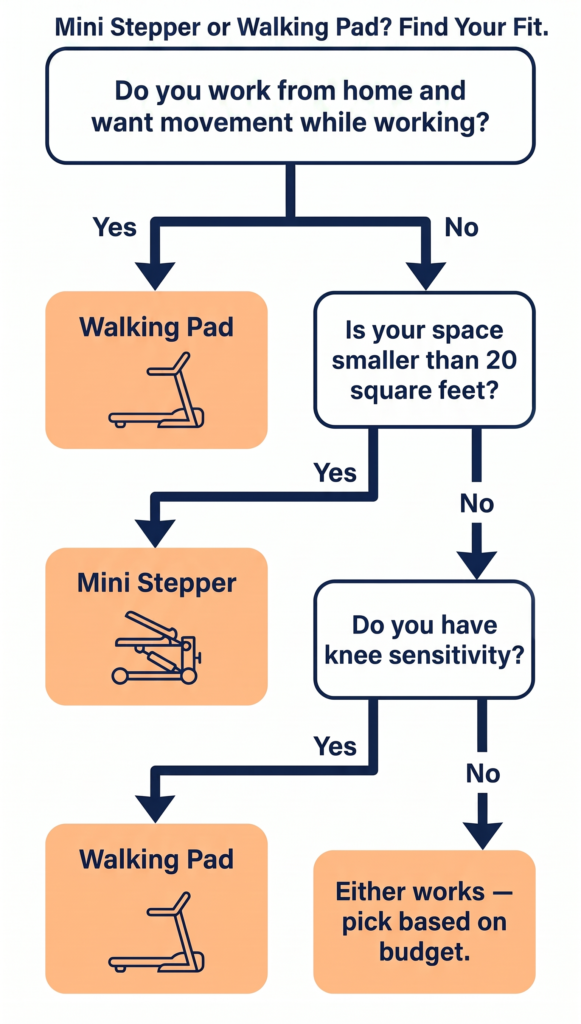
- Buy a walking pad if: you work from home and want background movement, you have any knee sensitivity, your apartment has a narrow open strip of floor, or you know you won’t sustain focused 20-minute workout blocks.
- Buy a mini stepper if: your space is genuinely tiny (studio, shared room), you want a fast high-intensity session rather than background movement, you have hip or lower-back sensitivity rather than knee issues, or your budget is under $100 (most mini steppers land in the $50–$100 range vs. $150–$400+ for a decent walking pad).
Mini Stepper vs Walking Pad: Quick Comparison Table
| Factor | Mini Stepper | Walking Pad |
|---|---|---|
| Calorie burn (30 min) | ~200–400 kcal | ~150–200 kcal |
| Best for | Short, intense sessions | Long, background movement |
| Joint consideration | Watch for knee-specific issues | Gentler for knees, natural gait |
| Noise profile | Impact/rocking noise on hard floors | Motor hum + rhythmic footfall over time |
| Desk multitasking | Not practical | Very practical at low speeds |
| Footprint | Smallest (15–20″ wide) | Larger in use, foldable for storage |
| Typical price | $50–$100 | $150–$400+ |
| Muscle focus | Quads, glutes, calves | Full gait chain, closer to natural walking |
FAQs
Do mini steppers actually help you lose weight?
Yes, when used consistently — a 30-minute session burns roughly 200–400 calories, and the resistance component builds lower-body muscle that supports a higher resting metabolic rate over time. Weight loss still comes down to overall calorie balance, not the machine alone.
Is a walking pad as effective as outdoor walking?
Very close. The gait pattern is nearly identical, and you get the same cardiovascular benefit. The main difference is that outdoor walking is weight-bearing on varied terrain, which adds a small bone-density and balance-training benefit that a flat belt doesn’t fully replicate.
Can I put a mini stepper or walking pad on carpet?
Yes, and it usually helps with noise — carpet adds a layer of impact absorption for both machines. For hard floors (hardwood, tile, laminate), add a dedicated exercise mat underneath either machine.
Are mini steppers bad for your knees?
Not inherently. They’re constant-contact, low ground-impact machines. The concern is for people with existing patellofemoral (kneecap-area) pain, where sustained loaded flexion can aggravate symptoms — that’s a “check with a PT first” situation, not a “never use it” one.