
As a fifth year medical student who also trains at home, I look at equipment like a power rack through both a biomechanics and a real world durability lens. A rack that flexes under load or wobbles during a heavy set isn’t just annoying, it’s a joint safety issue, especially on unracking and re-racking a loaded bar. Everything below is filtered through that lens, not just spec sheets.
Training alone in your garage is dangerous without the right equipment. One failed squat rep with no safety bars can end your lifting career — or worse. A power rack solves that immediately. It turns your home gym into a safe environment where you can push real weight without ever needing a spotter.
But here’s what most buying guides won’t tell you: the wrong rack is almost as dangerous as no rack at all. A rack with loose welds, the wrong hole spacing for your bench height, or insufficient ceiling clearance creates real risk under heavy loads.
We analyzed build specs, owner reviews, and real-world feedback across dozens of models to find the seven racks that actually deliver on safety, durability, and long-term value — from under $400 to full commercial builds.
Who This Guide Is For
- Home gym lifters training alone (your most important use case)
- Garage gym builders starting from scratch or upgrading from squat stands
- Lifters comparing budget vs. mid-range vs. premium racks
- Anyone trying to figure out what fits in their space before spending $500+
If you’re looking for a simple squat stand for light work, this guide covers full power racks — four-post cages that give you complete safety coverage.
Quick Comparison: 7 Best Power Racks for Home Gym 2026
| Rack | Steel | Hole Spacing | Capacity | Price Range | Best For |
|---|---|---|---|---|---|
| Fitness Reality 810XLT | 14-gauge 2×2″ | 2″ standard | 800 lbs | ~$330 | Best under $400 |
| REP PR-1000 | 14-gauge 2×2″ | 2″ standard | 700 lbs | ~$350 | Best budget starter |
| Titan T-3 Series | 11-gauge 3×3″ | 5/8″ standard | 1,000+ lbs | ~$600–$750 | Best mid-budget |
| REP Fitness PR-4000 | 11-gauge 3×3″ | 1″ Westside | 1,000+ lbs | ~$900–$1,100 | Best overall |
| Rogue RML-390F | 11-gauge 3×3″ | 2″ standard | 1,000+ lbs | ~$1,100–$1,300 | Best no-bolt garage rack |
| REP PR-5000 V2 | 7-gauge 3×3″ | 1″ Westside | 1,500+ lbs | ~$1,200–$1,500 | Best for heavy lifters |
| Rogue RM-4 Monster | 11-gauge 3×3″ | 1″ Westside | 2,000+ lbs | ~$1,500+ | Best premium build |
Prices checked July 4, 2026.
Before You Buy: Measure These 3 Things First
Most bad power rack purchases come down to one of three measurement mistakes. Check these before you look at a single product.
1. Ceiling height
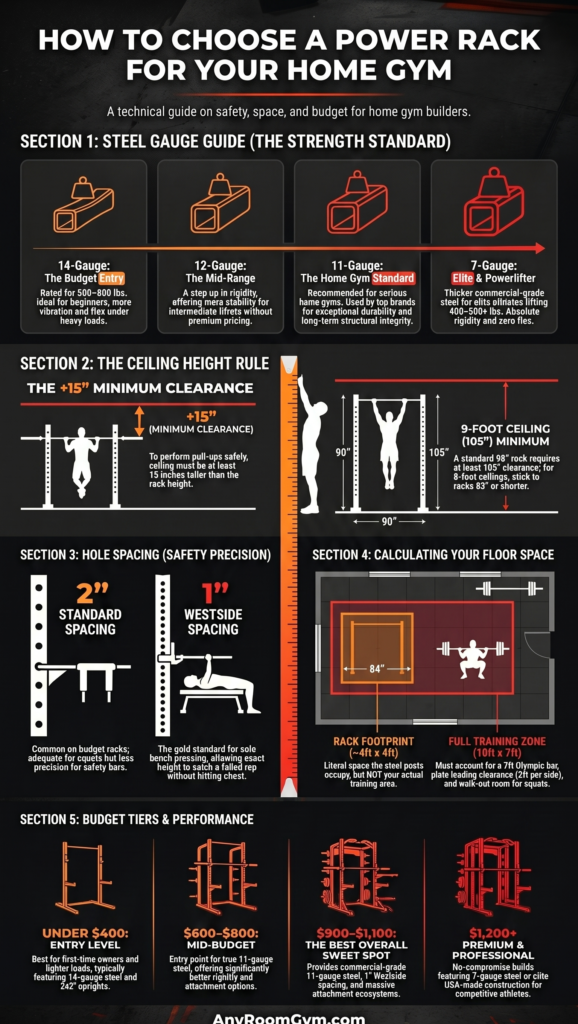
Standard home power racks range from 80″ to 96″ tall. Your ceiling needs to be at least 12–15″ taller than the rack to do pull-ups without hitting your head. For a typical 90″ rack, you need roughly 9 feet of ceiling clearance. If your garage has an 8-foot ceiling, stick to racks at or under 83″.
2. Floor footprint
A typical power rack takes up roughly 4 feet wide × 4 feet deep. But the real space you need is larger — add 3 feet in front for walkouts, and 2 feet on each side to load plates onto an Olympic barbell. Plan for at least 10 feet of width and 7–8 feet of depth for the full training zone.
3. Barbell sleeve clearance
Standard Olympic barbells are 7 feet long. Confirm the rack’s internal width and how far the sleeves extend when racked. Most quality racks clear a standard barbell easily, but always verify if you’re working in a tight space.
The 7 Best Power Racks for Home Gym
1. Fitness Reality 810XLT — Best Power Rack Under $400
Price: ~$329 | Steel: 14-gauge 2×2″ | Capacity: 800 lbs | Height: 83.5″
If your budget is under $400, the Fitness Reality 810XLT is the safest, most-reviewed budget power rack available. With over 5,000 Amazon ratings averaging 4.5 stars, it’s earned a reputation as the go-to starter cage for home gym builders who don’t want to compromise on safety.
The 14-gauge 2×2″ steel handles loads up to 500–600 lbs comfortably for the vast majority of home lifters. It’s not a rack you’ll grow a massive attachment system on, but for squats, bench, and overhead press, it does exactly what it needs to do safely.
Best for: First-time home gym owners, lifters under 250 lbs working weight, anyone needing a safe training space without a large investment.
Pros
- Most affordable safe power rack available
- 4.5+ stars across 5,000+ reviews
- 83.5″ height fits standard 8-foot ceilings
- Easy assembly (~90 minutes)
Cons
- 14-gauge steel (not as rigid as 11-gauge under very heavy loads)
- Limited attachment ecosystem
- 2×2″ uprights mean fewer premium third-party attachments
2. REP Fitness PR-1000 — Best Budget Rack With Room to Grow
Price: ~$350–$450 | Steel: 14-gauge 2×2″ | Capacity: 700 lbs | Height: 84″
The REP PR-1000 is the entry point into REP’s ecosystem, and it’s smarter than most budget racks because it supports an optional plate storage add-on that anchors the rack without bolting. That means you can set it up on concrete without drilling — and the storage keeps your plates organized at the same time.
At 84″ tall, it fits comfortably under standard ceilings. It’s not the most rigid rack under very heavy loads, but for most lifters in the 185–315 lb working weight range, it delivers solid, reliable safety.
Best for: Budget builders who want to avoid bolting, or lifters planning to add plate storage over time.
Pros
- No-bolt option with plate storage attachment
- Fits 8-foot ceilings
- REP Fitness customer service is excellent
- Lifetime structural warranty
Cons
- 700 lb capacity is lower than 11-gauge competitors
- Smaller attachment ecosystem than PR-4000
- Less structural rigidity under very heavy loads
3. Titan T-3 Series — Best Mid-Budget Power Rack
Price: ~$600–$750 | Steel: 11-gauge 3×3″ | Capacity: 1,000+ lbs | Height: Multiple options
The Titan T-3 is the most popular entry into true commercial-grade steel at an accessible price. Moving from 14-gauge to 11-gauge steel is a significant jump in rigidity — you’ll feel the difference immediately under heavy squats. The 3×3″ uprights open up a wide range of Titan attachments, and the company offers multiple height and depth configurations.
The T-3 uses 5/8″ hole spacing, which is a step below the 1″ Westside spacing on REP’s racks — but for most lifters it’s more than adequate. Titan’s powder coat and weld finish aren’t as clean as Rogue’s, but the structural quality is genuine.
Best for: Lifters ready to move past budget racks, garage gym builders who want real 11-gauge steel without spending $1,000+.
Pros
- True 11-gauge 3×3″ steel construction
- Wide range of Titan attachment compatibility
- Multiple height and flat-foot options available
- Frequently on sale directly from Titan
Cons
- Finish quality lower than Rogue or REP
- Occasional hardware tolerance issues (check hole alignment before fully assembling)
- 5/8″ hardware limits some premium third-party attachments
4. REP Fitness PR-4000 — Best Overall Power Rack for Home Gym ⭐
Price: ~$900–$1,100 | Steel: 11-gauge 3×3″ | Capacity: 1,000+ lbs | Height: 80″ or 93″
This is the rack we’d recommend to most serious home gym lifters. The PR-4000 sits at the sweet spot between commercial-grade construction and realistic home gym pricing — and it does it with one key feature most competitors at this price can’t match: 1″ Westside hole spacing throughout the bench zone.
Westside spacing means you can move your safety bars in 1″ increments instead of 2″ increments. When you’re benching alone and setting the safeties to catch a failed rep at the exact right height, that precision matters. It’s the single most important safety feature for solo bench pressing.
The PR-4000’s attachment ecosystem is one of the largest outside of Rogue, including cable towers, lat pulldown systems, lever arms, dip bars, and more. Laser-cut upright numbers make adjustments fast. Multiple depth and height options let you match it to your space.
Best for: Intermediate to advanced home gym lifters who want a rack that will grow with them for 10+ years.
Pros
- 1″ Westside spacing for precise safety placement
- Massive REP attachment ecosystem
- Laser-cut numbering on every hole for fast setup
- Excellent structural rigidity under very heavy loads
- Choose from 80″ or 93″ height options
Cons
- Bolting recommended at very heavy weights
- Assembly takes 2–3 hours
- Shipping costs vary by location
5. Rogue RML-390F Flat Foot — Best Garage Gym Rack (No Bolting)
Price: ~$1,100–$1,300 | Steel: 11-gauge 3×3″ | Capacity: 1,000+ lbs | Height: 90″
Rogue’s flat-foot design solves the single biggest problem garage gym owners face: you can’t always bolt your rack into a concrete floor. The RML-390F’s wide, extended base distributes weight outward so that once loaded with plates, the rack stays anchored without a single hole drilled into your floor.
Rogue’s build quality is genuinely industry-leading — the welds are clean, the powder coat is durable, and the hardware tolerances are tighter than any other manufacturer at this price. If you want a rack that will still be in perfect condition 20 years from now, Rogue is how you get there.
The 2″ standard hole spacing is the one trade-off vs. the REP PR-4000 — Rogue’s Infinity attachment line is excellent, but 1″ Westside spacing gives more precise bench safety placement.
Best for: Garage gym builders who cannot drill into their floor and want the most durable rack available.
Pros
- Flat-foot design — no drilling or bolting required
- Rogue’s best-in-class build quality and weld finish
- Made in the USA
- Enormous Rogue Infinity attachment ecosystem
- Exceptional long-term durability
Cons
- 2″ hole spacing (not Westside)
- Premium price
- Larger footprint than standard racks
6. REP PR-5000 V2 — Best Power Rack for Heavy Lifters
Price: ~$1,200–$1,500 | Steel: 7-gauge 3×3″ | Capacity: 1,500+ lbs | Height: 80″ or 93″
The PR-5000 is the only rack on this list built with 7-gauge steel — noticeably thicker than the 11-gauge standard. Under 400+ lb working loads, this difference becomes tangible: the rack simply doesn’t flex, shimmy, or transmit vibration the way lighter-gauge steel does. It also supports one of REP’s largest attachment configurations, including 13 different add-ons and five pull-up bar profiles.
This is overkill for most home lifters. But if you’re genuinely squatting or deadlifting in the 400–600+ lb range and you need absolute confidence in your equipment, the PR-5000 is the answer.
Best for: Competitive powerlifters, strength athletes with elite lifting numbers, or lifters who simply want the most rigid rack that exists at a non-commercial price.
Pros
- 7-gauge steel uprights — exceptional rigidity
- 1″ Westside spacing
- Largest REP attachment compatibility
- 1,500+ lb rated capacity
- Five pull-up bar profile options
Cons
- Expensive for what most lifters actually need
- Very heavy — assembly requires two people
- May be genuine overkill under 350 lb working weights
7. Rogue RM-4 Monster — Best Premium Power Rack
Price: ~$1,500–$2,000+ | Steel: 11-gauge 3×3″ | Capacity: 2,000+ lbs | Height: 90″–108″
The Rogue Monster line sets the standard for commercial-grade home gym equipment. The RM-4 uses Rogue’s Monster hardware (1″ uprights, 1″ Westside spacing) and is built to the same spec as what you’d find in professional strength facilities. The attachment ecosystem is the largest available anywhere — anything you might want to add to your rack, Rogue makes it.
It requires bolting, commands a premium price, and has longer lead times than other options. But if you want the single best-built rack available for a home gym with no compromises, this is it.
Best for: Competitive powerlifters building a permanent, professional-grade training space.
Pros
- 1″ Westside spacing with Monster 1″ hardware
- Largest attachment ecosystem in the industry
- Exceptional weld quality and durability
- 2,000+ lb capacity
- Sets the industry standard for construction
Cons
- Requires bolting to floor
- Highest price point on this list
- Longer lead times on some configurations
Power Rack Buying Guide: What the Specs Actually Mean
Steel gauge — the number that matters most
Steel gauge works backwards: a lower number means thicker steel.
- 14-gauge — budget category. Safe for most home lifters under 400 lb working weight. Handles the job, but you’ll feel more flex and vibration under heavy loads.
- 12-gauge — mid-tier. Noticeably stiffer. Good balance of price and rigidity.
- 11-gauge — the standard for serious home gyms. Used by REP, Rogue, and Titan in their main lines. What you want for heavy, long-term training.
- 7-gauge — commercial/elite level. Only found on racks like the REP PR-5000. Overkill for most home lifters, but genuinely different under 400+ lb loads.
Upright size: 2×2″ vs 3×3″
Budget racks use 2×2″ uprights. Mid-range and premium racks use 3×3″. The difference matters because 3×3″ uprights accept a wider range of attachments — including higher-quality third-party accessories. If you’re planning to expand your rack with a cable system or lat pulldown, 3×3″ is worth the upgrade.
Hole spacing: 5/8″, 1″, and Westside
- 2″ standard spacing — most common. Works fine for squats. Less precise for bench safety placement.
- 5/8″ spacing — Titan’s standard. Good precision, fits a wide range of attachments.
- 1″ Westside spacing — the most precise option. Found on REP PR-4000, PR-5000, and Rogue Monster lines. Critical for solo bench pressing — lets you set safeties at the exact height to catch a failed rep without hitting your chest.
Do you need to bolt your rack down?
Not always, but it depends on your setup. Bolting is strongly recommended if you’re doing dynamic movements like kipping pull-ups, hanging heavy attachments like lat pulldown systems, or working with a lighter rack frame. For standard barbell training, a rack weighing 350+ lbs on stable concrete flooring can be safe without bolting — especially with plate storage adding weight to the base. The Rogue RML-390F is purpose-designed for stability without drilling.
Which Power Rack Should You Buy?
Budget under $400 → Fitness Reality 810XLT Safe, well-reviewed, fits standard ceilings. The right answer for people starting out.
Budget under $600 → REP PR-1000 Better warranty and no-bolt option via plate storage. REP’s customer service is genuinely good.
Best value mid-range → Titan T-3 Real 11-gauge steel at a significantly lower price than REP or Rogue.
Best overall for most people → REP PR-4000 The right combination of steel quality, Westside spacing, attachments, and long-term value.
Can’t bolt, want the best → Rogue RML-390F Purpose-built for garage gyms. Will outlast every other rack on this list by years.
Heavy lifter (400+ lb lifts) → REP PR-5000 V2 The 7-gauge steel difference is real at extreme loads.
No compromise, maximum quality → Rogue RM-4 Monster The professional standard.
What’s the Best Power Rack for a Low Ceiling or Small Garage?
If your ceiling is under 7 feet or your garage is on the tighter side, look for a rack under 72 inches tall with a shorter footprint, most standard racks assume an 8 foot ceiling minimum. A flat foot, non anchored design also matters more in a small garage since you likely won’t want to bolt into a shared or rented structure. If budget is the main constraint, several solid options come in under $500, though at that price expect a shorter height range and fewer accessory mounts than premium racks.
Frequently Asked Questions
What is the best power rack for a small home gym?
For small spaces, look at the REP PR-4000 in the 80″ height with 16″–24″ depth configurations, or the Force USA MyRack. Both offer serious training capability in a smaller footprint than most full-size racks. Always measure your ceiling height and floor space first — a rack that doesn’t fit your ceiling is useless regardless of quality.
What ceiling height do I need for a power rack?
Your ceiling needs to be at least 12–15 inches taller than your rack to complete pull-ups safely. For a standard 90″ (7.5 foot) rack, plan for at least 9 feet of ceiling clearance. If your garage ceiling is exactly 8 feet, stick to racks at 80–83″ tall and verify clearance before purchasing.
Do I need to bolt my power rack to the floor?
Not always. Racks weighing 350+ lbs on concrete with a stable base can be used safely for standard barbell training without bolting. If you’re doing kipping pull-ups, hanging a cable system, or using a lighter-frame rack, bolting adds critical stability. The Rogue RML-390F is specifically engineered for no-bolt stability via its flat-foot design.
What’s the difference between 5/8″ and 1″ holes on a power rack?
The holes refer to the hardware (J-cups, safety bars) pin diameter. 1-inch holes with Westside spacing allow more precise placement in 1-inch increments instead of 2-inch increments. This matters most for bench pressing alone — you can set your safeties at the exact height to catch a failed rep safely. For squatting, the difference is less critical.
What steel gauge should I look for in a power rack?
For serious home gym use, 11-gauge steel is the right minimum. 14-gauge is adequate for lighter loads but less rigid under heavy compound lifts. 11-gauge is what Rogue, REP, and Titan use in their mainstream racks, and it’s more than sufficient for 99% of home lifters. Only go to 7-gauge (like the REP PR-5000) if you’re regularly lifting at elite loads (400+ lbs).
How much space does a power rack take up?
A standard power rack footprint is roughly 48–52 inches wide × 24–50 inches deep. But your real training zone needs to be larger — plan for 10 feet of width for barbell sleeve clearance, and 6–8 feet of depth for walkouts and bench setup. Also leave 6–12 inches behind the rack for plate loading.
Power rack vs squat rack — which is better for a home gym?
For solo training, a power rack wins clearly. A power rack surrounds you with four posts and adjustable safety bars that catch the bar if you fail a lift. A squat rack or half rack has only two posts and less safety coverage. Unless space is extremely limited, a power rack is the safer long-term choice for home gym training without a spotter.
What is the best budget power rack under $500?
The Fitness Reality 810XLT (~$329) and REP PR-1000 (~$350–$450) are the two strongest options under $500. Both provide safe, reliable lifting platforms. The Fitness Reality 810XLT has more reviews and broader real-world feedback; the REP PR-1000 offers a better warranty and the no-bolt plate storage option.
How much does a good home gym power rack cost?
Entry-level safe racks start around $300–$400 (Fitness Reality 810XLT, REP PR-1000). Mid-range 11-gauge racks run $600–$1,100 (Titan T-3, REP PR-4000). Premium builds from Rogue or REP’s heavy-duty lines range from $1,200–$2,000+. For most serious home gym lifters, the $800–$1,100 sweet spot (REP PR-4000, Titan T-3) delivers commercial-quality steel without commercial pricing.
Does a power rack need to be assembled by a professional?
No. Every rack on this list is designed for home assembly with included hardware and instructions. Budget expect 1.5–2 hours for entry-level racks and 2–4 hours for full-size commercial-grade racks. Heavier racks (PR-5000, Rogue RM-4) benefit from a second person during assembly.
Final Verdict
The best power rack for your home gym is the one that matches your ceiling height, floor space, training intensity, and long-term plans — not just the one with the most impressive specs sheet.
For most home lifters: the REP PR-4000 delivers the best combination of safety, attachment ecosystem, and genuine long-term value.
For lifters on a budget: the Fitness Reality 810XLT or REP PR-1000 are the safest choices under $500 without sacrificing the structural integrity that keeps you safe under heavy loads.
For garage gym owners who can’t bolt: the Rogue RML-390F is worth every extra dollar.
Whatever you choose — prioritize steel gauge, hole spacing for your training style, and ceiling clearance above everything else. Get those three things right and your rack will serve as the foundation of your strength training for the next decade.
Looking to pair your rack with the right barbell? Read our Ultimate Olympic Barbell Guide for Home Gym for the best bars at every budget.
Training with a walking pad alongside your strength work? See our Zone 2 Walking Speed Guide for the cardio setup that pairs perfectly with home strength training.