
Introduction
You finally bought a walking pad. You’re ready to crush your daily step goals, shed some pounds, and stay active while working from home. But three weeks in, the scale hasn’t budged, your knees ache, and that sleek under-desk treadmill is collecting dust in the corner.
Sound familiar?
Many people don’t realize that most walking pad mistakes beginners make are simple habit errors, not equipment problems.
Walking pads have exploded in popularity, and for good reason. They make walking convenient, weather proof, and easy to fit into a busy schedule. But convenience alone doesn’t deliver results. How you use it matters more than owning one.
Most beginners make predictable mistakes that sabotage fat loss, kill motivation, and sometimes even cause discomfort. The good news? These mistakes are easy to fix once you know what to look for.
What are the most common walking pad mistakes beginners make?
The most common walking pad mistakes beginners make include walking too slowly, holding the rails, inconsistent step counts, poor posture, and expecting rapid weight loss. These errors reduce calorie burn and often prevent people from seeing meaningful fat loss results.
Why Most Beginners Use a Walking Pad the Wrong Way
Walking seems simple. You’ve been doing it since age one. But using a walking pad effectively for weight loss requires more than just standing on it while answering emails.
The disconnect usually comes from expectations. People assume that because walking is “easy,” they can half-step their way to dramatic results. When the scale doesn’t move, they blame the equipment rather than their approach.
Here’s the reality: A walking pad is a tool. Like any tool, it works best when used correctly. Proper setup, consistent habits, and realistic expectations make the difference between a dust collector and a fat-loss weapon.
The Most Common Walking Pad Mistakes Beginners Make
Here are the nine most common walking pad mistakes beginners make and exactly how to avoid them.
Mistake #1 — Walking Too Slowly
Walking at a leisurely 1.0 mph while scrolling Instagram might feel productive, but it’s barely above standing still. At that pace, you’re burning roughly the same calories as folding laundry.
Why it hurts fat loss: Fat loss requires energy expenditure. Walking too slowly keeps your heart rate in a range that does little to challenge your cardiovascular system or create meaningful calorie burn.
The fix: For weight loss, aim for 2.5 to 3.5 mph. This pace should feel like you’re intentionally moving, breathing slightly harder but still able to hold a conversation. This is your low intensity cardio sweet spot, often called Zone 2 training.
If 2.5 mph feels challenging at first, start at 2.0 and increase by 0.1 mph every few days. Your body adapts quickly.
Mistake #2 — Holding the Rails Constantly
Gripping the front rail or handlebar might feel secure, but it’s destroying your results. When you lean on the rails, you offload up to 30% of your body weight, meaning your legs do less work and you burn fewer calories.
Why it hurts fat loss: You’re essentially cheating yourself out of effort. Plus, it ruins your posture and teaches your body to walk in a hunched, unnatural position.
The fix: Walk hands-free. Keep your arms bent at 90 degrees and let them swing naturally. This engages your core, improves balance, and increases calorie burn. If you feel unsteady, slow down until you can walk without support.
Mistake #3 — Inconsistent Daily Step Count
Walking 10,000 steps on Monday, then 2,000 on Tuesday, then nothing until Friday creates chaos for your metabolism. Your body responds to consistency, not sporadic heroics.
Why it hurts fat loss: Weight loss happens through sustained habits, not occasional bursts. Inconsistent walking fails to build momentum or create the daily calorie deficit needed for fat loss.
The fix: Focus on non-exercise activity thermogenesis (NEAT)—the calories you burn through daily movement. Walking is the easiest way to increase NEAT.
Start with a baseline: 5,000 steps daily for one week. Add 500 steps each week until you hit 8,000–10,000 consistently. The exact number matters less than showing up daily.
Research consistently shows that sustainable fat loss typically occurs at a rate of 0.5–1% of body weight per week.
Mistake #4 — Expecting Fast Weight Loss
Walking 30 minutes a day for one week will not undo years of sedentary habits. Yet many beginners quit when they don’t see immediate results.
Why it hurts fat loss: Unrealistic expectations lead to quitting before results have time to appear. Fat loss is slow, and walking contributes to it gradually through cumulative calorie burn.
The fix: A reasonable fat loss rate is 0.5 to 1 pound per week. To lose one pound, you need a 3,500 calorie deficit. Walking at 3 mph burns roughly 100–150 calories per mile. Do the math—it takes time.
Use your walking pad as one piece of the puzzle, not the magic bullet.
Mistake #5 — Poor Walking Pad Posture
Hunching over your phone, looking down at a tablet, or leaning forward strains your neck and lower back. Poor posture also reduces how effectively you engage your glutes and core.
Why it hurts fat loss: When your body is misaligned, you recruit fewer muscle fibers with each step. Less muscle engagement means fewer calories burned per minute.
The fix: Walk tall. Imagine a string pulling the top of your head toward the ceiling. Keep your shoulders back and down, gaze forward (not at your feet), and engage your core lightly. If you’re working at a desk, position your screen at eye level.
Mistake #6 — Skipping Incline or Intensity Progression
Walking the same speed, same duration, same everything for months leads to a plateau. Your body adapts to demands placed on it. If you never increase the challenge, it stops adapting.
Why it hurts fat loss: Progressive overload, gradually increasing exercise demands, is necessary for continued improvement. Without it, your calorie burn stagnates.
The fix: If your walking pad has an incline, use it. A 3–5% incline significantly increases calorie burn without requiring faster walking. No incline? Increase speed by 0.1–0.2 mph every week or two, or add 5 minutes to your session.
Mistake #7 — Walking Only Once in a While
The “all or nothing” mindset kills progress. Walking twice a week feels better than zero, but it won’t move the needle for weight loss.
Why it hurts fat loss: Fat loss favors frequency over intensity. Walking most days of the week builds a habit and keeps your daily calorie burn elevated. Occasional walks do neither.
The fix: Aim for at least 5 days per week. Even 20 minute sessions count. Short daily walks beat long walks twice a week every time.
Mistake #8 — Ignoring Heart Rate Zones
Not all walking is created equal. Strolling at 1.5 mph keeps you in a very low heart rate zone that barely challenges your aerobic system. Walking at a brisk pace shifts you into Zone 2, the sweet spot for fat burning.
Why it hurts fat loss: In Zone 2, your body relies more on fat for fuel. Below Zone 2, you burn mostly glucose and very few calories overall.
The fix: Use the “talk test.” You should be able to speak in full sentences but feel slightly breathy when doing so. If you can sing, speed up. If you’re gasping, slow down. For most people, this happens between 2.5 and 3.5 mph.
Mistake #9 — Not Combining with Strength Training
Walking alone will not transform your body. It burns calories and improves cardiovascular health, but it does little to build or preserve muscle.
Why it hurts fat loss: Muscle is metabolically active, it burns calories at rest. When you lose weight through walking alone, up to 25% of that weight loss can come from muscle instead of fat. Less muscle means a slower metabolism.
The fix: Add two strength sessions per week. Bodyweight squats, lunges, push ups, and resistance bands require minimal equipment and preserve muscle during fat loss. Think of walking as your daily movement foundation and strength training as the structure that holds everything together.
Before we dive deeper into speed zones and step goals, here’s a beginner friendly walking pad workout you can follow along with at home:
Best Walking Pad Speed for Weight Loss (Beginner Guide)
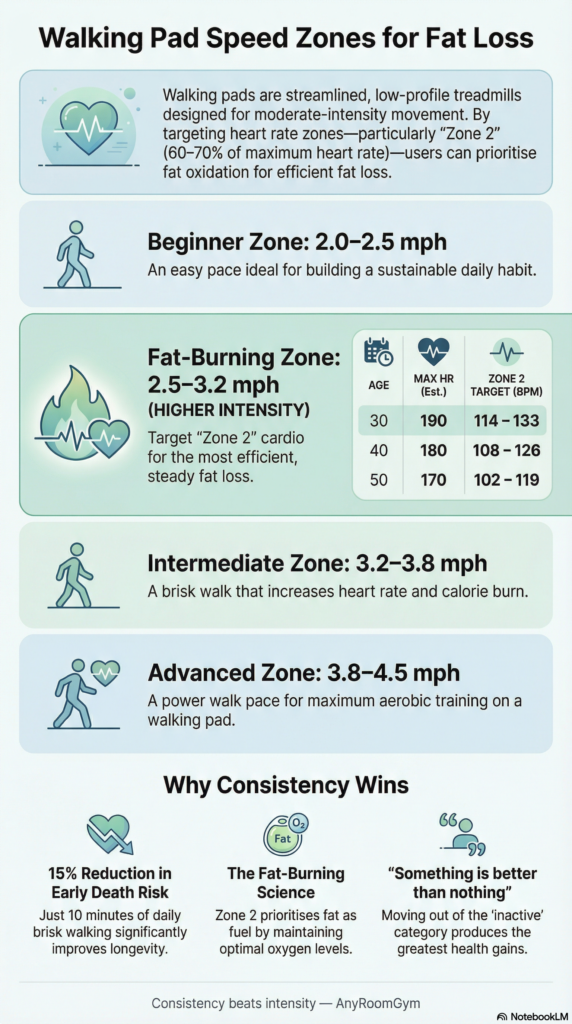
Finding your ideal speed doesn’t require guesswork. Here’s a simple progression framework:
| Level | Speed (mph) | Perceived Effort | Duration |
|---|---|---|---|
| Beginner | 2.0–2.5 | Easy, barely breathy | 20–30 min |
| Fat-burning zone | 2.5–3.2 | Brisk, can talk but not sing | 30–45 min |
| Intermediate | 3.2–3.8 | Moderate, slightly breathy | 30–45 min |
| Advanced | 3.8–4.5 | Brisk walk/jog hybrid | 20–30 min |
Zone 2 reference: At 2.5–3.2 mph, most beginners hit their aerobic fat-burning zone. This is where your body uses a higher percentage of fat for fuel. For a more detailed review read our article about zone 2.
Walking Pad vs Outdoor Walking (Quick Comparison)
| Factor | Walking Pad | Outdoor Walking |
|---|---|---|
| Convenience | High | Medium |
| Weather dependence | None | High |
| Step consistency | Very high | Variable |
| Calorie burn | Similar | Similar |
How Many Steps Per Day on a Walking Pad to Lose Weight?
Step goals should match your current fitness level. Using 10,000 steps as a starting point often overwhelms beginners.
| Level | Daily Step Goal | Walking Pad Contribution |
|---|---|---|
| Sedentary beginner | 4,000–5,000 | 2,000–3,000 steps |
| Active beginner | 6,000–8,000 | 3,000–5,000 steps |
| Weight loss focus | 8,000–10,000 | 5,000–7,000 steps |
| Aggressive fat loss | 10,000–12,500 | 7,000–10,000 steps |
Remember: These steps add to your baseline daily movement. If you work from home, a 45-minute walk at 3 mph adds roughly 5,000 steps.
Simple Walking Pad Daily Routine for Beginners
Consistency beats intensity. Here’s a sustainable week one plan:
Monday: 20 minutes at 2.2 mph
Tuesday: 20 minutes at 2.3 mph
Wednesday: Rest or 15 minutes easy
Thursday: 22 minutes at 2.3 mph
Friday: 22 minutes at 2.4 mph
Saturday: 25 minutes at 2.3 mph
Sunday: Active rest (gentle walk, no pressure)
Week 2: Add 5 minutes to each session.
Week 3: Increase speed by 0.1–0.2 mph.
Week 4: Add incline if available, or extend one session to 40 minutes.
Safety Tips When Using a Walking Pad at Home
- Give it space: Keep at least 3 feet of clearance behind the pad in case you lose balance.
- Start slow: Begin each session at 1.5–2.0 mph to find your rhythm before speeding up.
- Wear proper shoes: Supportive walking shoes beat barefoot or casual flats.
- Stay centered: Walk near the front but not against the motor cover. Centered walking reduces wear on the belt and keeps you balanced.
- Use the safety key: If your pad has one, clip it to your clothing. It stops the belt if you fall.
- Cool down: Never step off a moving belt. Slow to 1.5 mph for 2–3 minutes before stopping.
Frequently Asked Questions
Is a walking pad effective for weight loss?
Yes, when used consistently and at an appropriate intensity. A walking pad helps create the daily calorie deficit needed for weight loss, especially when combined with dietary changes. It’s most effective as a tool for increasing daily step count and NEAT activity.
Can you use a walking pad every day?
Absolutely. Walking is low-impact and safe for daily use. In fact, daily walking builds the consistency needed for fat loss. Just listen to your body if you feel joint discomfort, take a rest day or walk at a slower pace.
What speed should beginners use?
Start at 2.0–2.2 mph for the first week. Focus on building duration before speed. Once you can walk 30 minutes comfortably, gradually increase speed by 0.1 mph every few days until you reach 2.5–3.2 mph, your fat-burning zone.
Does walking pad count as cardio?
Yes. Walking is a form of low intensity steady state cardio (LISS). It improves cardiovascular health, increases endurance, and burns calories, all without the joint stress of running.
Final Verdict: Use Your Walking Pad the Right Way
A walking pad won’t transform your body on its own. But used correctly with proper speed, posture, consistency, and realistic expectations, it becomes one of the most effective tools for weight loss and daily movement.
Start slow. Show up daily. Increase gradually. And remember: walking is supposed to feel good. If it hurts, you’re pushing too hard. If it’s boring, add music or podcasts. If results are slow, trust the process.
The nine mistakes above are easy to make and equally easy to fix. Avoid them, and your walking pad becomes what you always hoped it would be a simple, sustainable path to better health.
Now go take a walk. Your body will thank you.