
Most people who buy a walking pad never actually reach their fat-burning potential. Here’s the problem: they either walk too fast, pushing their heart rate into an uncomfortable zone they can’t sustain, or they stroll too slowly, spending hours on the pad with minimal metabolic payoff.
Quick Answer:
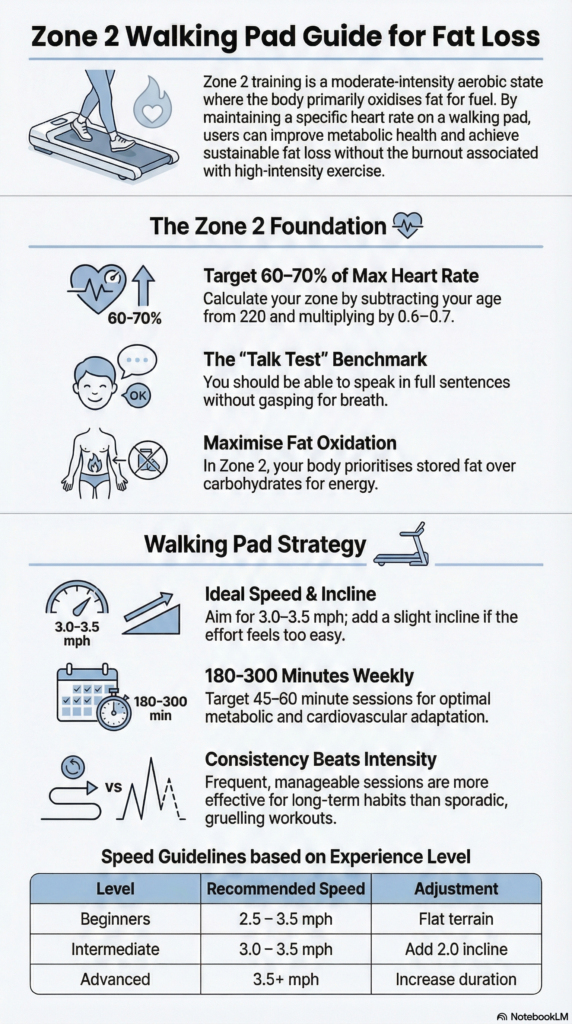
For most people, Zone 2 walking pad speed is between 3.0–3.5 mph (4.8–5.6 km/h), keeping heart rate at 60–70% of maximum. Use the talk test: you should be able to speak in full sentences but not sing.
The science is clear. There’s a specific intensity window Zone 2 where your body shifts from burning mostly sugar to burning primarily fat for fuel. And here’s what most fitness content won’t tell you: for the average person, this happens at a walking speed that feels almost frustratingly slow.
Let’s cut through the confusion. This guide gives you the exact walking pad speed, heart rate targets, and science backed protocols to finally make your walking pad the fat loss tool it was meant to be.
What Is Zone 2 Walking? (Simple Explanation)
Zone 2 walking refers to cardiovascular exercise performed at an intensity where your body can clear lactate as quickly as it produces it. In plain English? You’re working hard enough to get benefits, but easy enough that you could maintain the pace for hours.
In the five-zone heart rate model, Zone 2 sits at 60–70% of your maximum heart rate. For most people, this corresponds to:
- A brisk walk that requires effort
- Breathing that’s deeper but still comfortable
- The ability to hold a full conversation (with slightly longer pauses between sentences)
Why does this matter for beginners especially? Because Zone 2 builds your aerobic foundation without destroying your joints, crushing your motivation, or requiring recovery days. It’s the “work you can do every day” zone and consistency beats intensity every time for long term results.
Why Zone 2 Walking Burns More Fat
The physiology here matters, but I’ll keep it digestible.
When you exercise in Zone 2, several things happen:
Your mitochondria multiply. These are the power plants inside your cells. More mitochondria means your body gets better at using oxygen to produce energy and fat requires oxygen to burn.
Fat oxidation peaks. At lower intensities, your body preferentially burns fat for fuel. As intensity increases, carbohydrate becomes the primary energy source. Zone 2 sits at the sweet spot where fat contribution to energy production is maximized.
You build aerobic base. This is the foundation every athlete needs. A stronger aerobic system means you recover faster between workouts, handle higher training volumes, and yes burn more fat throughout the day, not just during exercise.
Sustainability beats HIIT for most people. High intensity interval training has its place, but it also increases hunger, stresses the nervous system, and requires recovery. Zone 2 walking? You can do it daily, often while working, watching TV, or reading. The total calorie burn over weeks and months typically exceeds what most people achieve with sporadic HIIT sessions they dread.
Zone 2 Walking Pad Speed (Exact Numbers)
Here’s where we get practical. What speed should you set on your walking pad?
General Range:
- Beginners: 2.5–3.5 mph (4–5.6 km/h)
- Intermediate: 3.0–4.0 mph (4.8–6.4 km/h)
- Advanced/Fit Individuals: May need incline rather than speed increases
But here’s the critical point: speed is a starting point, not a rule.
Several factors affect your Zone 2 speed:
| Factor | Impact on Speed |
|---|---|
| Fitness level | Fitter individuals walk faster at same heart rate |
| Age | Same speed produces higher heart rate as you age |
| Leg length | Taller people cover more ground per stride |
| Incline | Adding incline lowers required speed |
| Time of day | Heart rate varies by 5–8 beats throughout day |
The smarter approach: Start at 2.5 mph (4 km/h). Walk for 5 minutes. Check your breathing. Can you speak comfortably? Increase speed by 0.2 mph every 2–3 minutes until you find the pace where conversation becomes slightly challenging but still possible. That’s your Zone 2 speed.
Most people reach Zone 2 walking pad intensity at 3.0–3.5 mph on a flat surface. However, the exact speed varies based on fitness level, age, and incline. Always confirm using heart rate (60–70% max) or the talk test.
If you want to understand exactly how different speeds impact your calorie burn and results, check out our detailed guide on walking pad speed for weight loss.
How to Calculate Your Zone 2 Heart Rate
According to the American Heart Association, Heart rate is more accurate than speed because it accounts for how your body actually responds to exercise on any given day.
Method 1: The 220-Minus-Age Formula
Calculate your maximum heart rate: 220 − your age.
Then take 60–70% of that number.
Example for a 40 year old:
- Max HR: 220 − 40 = 180 beats per minute
- Zone 2 range: 108–126 bpm (60–70% of 180)
Method 2: The Talk Test (Surprisingly Accurate)
Walk at a pace where:
- You can speak in complete sentences
- You can’t sing comfortably
- Your breathing is noticeable but not gasping
Research shows the talk test correlates strongly with actual lactate threshold for most people.
Method 3: Wearable Devices
Heart rate monitors, fitness watches, and even some walking pads with pulse sensors can track your heart rate continuously. Just ensure the strap or watch is snug.
Note for women: Hormonal fluctuations throughout the menstrual cycle can affect heart rate by 3–5 beats per minute. The talk test becomes especially valuable during these variations.
If you want to see what proper Zone 2 walking looks like, watch this quick demonstration below.
How Long Should You Walk in Zone 2?
Duration matters as much as intensity. Here’s what the evidence supports:
For Beginners (First 4 Weeks)
- Start with 20–30 minute sessions
- Focus on consistency: 4–5 sessions per week
- Goal: Build habit and allow your body to adapt
For Fat Loss (After Adaptation)
- Minimum effective dose: 45 minutes per session
- Optimal: 60–75 minutes
- Weekly volume target: 180–300 minutes total
Why longer sessions matter: The first 20–30 minutes of Zone 2 exercise burns through stored glycogen. After that, fat contribution to energy production increases significantly. A 60-minute walk in Zone 2 can derive 70–80% of its energy from fat stores.
For Aerobic Base Building
- 45–90 minute sessions
- 3–5 sessions weekly
- One longer session (90+ minutes) on weekends if possible
Common Zone 2 Walking Mistakes
These errors keep people stuck. Avoid them.
1. Walking Too Fast
The most common mistake. You push into Zone 3, increase fatigue, burn more sugar than fat, and can’t sustain the session length. If you’re breathing hard enough that conversation is difficult slow down.
2. Relying Only on Speed
Your Zone 2 speed changes with fatigue, sleep quality, and stress. Use heart rate or the talk test daily. What felt easy yesterday might push you into Zone 3 today.
3. Holding the Rails
This reduces calorie burn by 20–30%, alters your posture, and disengages your core. Walk naturally with arms swinging.
4. Poor Posture
Slouching forward limits lung expansion and reduces oxygen delivery. Stand tall, shoulders back, gaze forward.
5. Inconsistency
Zone 2 benefits accumulate. A 60-minute walk once weekly does less than 30 minutes five times weekly. Frequency matters.
6. Never Progressing
Your body adapts. After 4–6 weeks at the same pace and incline, you may need to increase speed or add incline to stay in Zone 2 as your fitness improves.
7. Ignoring Recovery
Zone 2 is “easy” but your body still needs sleep, hydration, and nutrition to adapt. Walking daily is fine but if you feel persistently drained, take a lighter day.
Zone 2 Walking vs HIIT (Which Is Better?)
This comparison creates unnecessary debate. Both have distinct purposes.
Zone 2 Walking Wins For:
- Daily consistency (can be done 6–7 days weekly)
- Joint health (low impact)
- Active recovery
- Building aerobic foundation
- Sustainable fat loss over months
- Mental clarity and low stress
HIIT Wins For:
- Time efficiency (shorter sessions)
- VO2 max improvement (peak oxygen uptake)
- Post-exercise calorie burn (EPOC effect)
- Breaking through plateaus
- Metabolic flexibility
The Smart Approach:
Do both but prioritize Zone 2.
A typical weekly breakdown for fat loss:
- 4–5 Zone 2 walking sessions (45–60 minutes)
- 1–2 HIIT sessions (20 minutes including warm-up)
This gives you the fat-burning base from Zone 2 and the metabolic spike from HIIT without the burnout or injury risk of daily high-intensity work.
For a complete weekly structure that balances both intensities, take a look at our home workout routine that incorporates walking pad sessions with complementary exercises.
Sample Zone 2 Walking Pad Workout Plan
Here’s a practical weekly template you can start tomorrow.
Beginner Plan (Weeks 1–4)
| Day | Duration | Target | Notes |
|---|---|---|---|
| Monday | 20 min | Zone 2 | Find your baseline speed |
| Tuesday | 20 min | Zone 2 | Focus on posture |
| Wednesday | Rest | – | Walk outdoors if desired |
| Thursday | 25 min | Zone 2 | Slight incline if too easy |
| Friday | 20 min | Zone 2 | Practice talk test |
| Saturday | 30 min | Zone 2 | Longer session |
| Sunday | Rest | – | Recovery |
Fat Loss Focus Plan (After Adaptation)
| Day | Duration | Type | Details |
|---|---|---|---|
| Monday | 45 min | Zone 2 walking | Flat, 3.0–3.5 mph |
| Tuesday | 30 min | Zone 2 + incline | 3% incline, slightly slower speed |
| Wednesday | 20 min | HIIT | 1 min fast / 2 min recovery x 5–7 |
| Thursday | 50 min | Zone 2 walking | Podcast or audiobook day |
| Friday | 40 min | Zone 2 walking | Focus on deep breathing |
| Saturday | 60–75 min | Long Zone 2 | Build endurance |
| Sunday | Rest or 30 min | Light walk | Active recovery |
Progression Tips:
- Add 5 minutes to one session weekly
- Once 60 minutes feels easy, add 0.5–1% incline before increasing speed
- Every 4 weeks, take a slightly lighter week (reduce volume by 20–30%)
Final Verdict: Is Zone 2 Walking Worth It?
Yes—with one caveat: it requires patience.
Zone 2 walking won’t give you the dramatic “after one workout” sweat drench of HIIT. It won’t leave you sore the next day. It won’t feel like you’re pushing limits.
What it will do is build a metabolic engine that burns fat more efficiently every hour of every day. It will improve your recovery, your sleep, your energy levels. It will make your harder workouts feel easier. And over 3, 6, 12 months, the cumulative fat loss and fitness gains typically exceed what most people achieve through sporadic high-intensity work they eventually quit.
The walking pad is the perfect tool for this—low barrier, accessible, and consistent. But only if you use it at the right intensity.
Set your speed based on heart rate and conversation, not ego. Walk longer, not harder. And trust the process.
❓ FAQ Section
Can walking keep you in zone 2?
Yes, absolutely. For most people, brisk walking at 3.0–3.5 mph (4.8–5.6 km/h) on flat ground keeps heart rate in the 60–70% range. Fit individuals may need to add incline to reach Zone 2, while deconditioned individuals might reach it at slower speeds.
Is zone 2 walking good for weight loss?
Yes, but with context. Zone 2 walking alone produces gradual weight loss. Combined with a slight calorie deficit, it’s highly effective because it’s sustainable—you can do it daily without burnout, creating consistent weekly calorie burn that adds up significantly over months.
How fast should I walk for zone 2?
Start at 2.5 mph (4 km/h) and increase 0.2 mph every few minutes until your breathing becomes slightly challenging but conversation remains possible. For most people, this ends up between 3.0–3.5 mph (4.8–5.6 km/h). Use heart rate or talk test to confirm.
How long should zone 2 cardio be?
Minimum 30 minutes for fat loss benefits. Optimal is 45–60 minutes. The first 20–30 minutes primarily burns glycogen; after that, fat contribution to energy production increases substantially. Beginners should start with 20–30 minutes and gradually increase duration.
Is zone 2 better than HIIT?
Neither is “better”—they serve different purposes. Zone 2 builds aerobic base, burns fat during exercise, and allows daily consistency. HIIT improves peak power, VO2 max, and creates post-exercise calorie burn. Most people benefit from 80% Zone 2 and 20% HIIT in their weekly routine.
What is the best exercise to stay in zone 2?
Walking is arguably the best because it’s accessible, low-impact, and easy to sustain for long durations. Other excellent options include cycling, elliptical, swimming, and incline hiking. The key is choosing something you’ll actually do consistently.
Does zone 2 training burn fat?
Yes. At Zone 2 intensity (60–70% max heart rate), fat is the primary fuel source. Your body increases fat oxidation, spares glycogen, and becomes more efficient at using stored fat for energy. Over time, this improves body composition and metabolic flexibility.