
Quick Answer: Adding a weighted vest to the 12-3-30 workout increases calorie burn by 12–18%, amplifies posterior chain muscle activation, and keeps your heart rate in the fat-burning zone without increasing joint stress. It is one of the most effective progressions for the 12-3-30 — but there are rules you must follow.
What Is the 12-3-30 Workout? {#what-is-12-3-30}
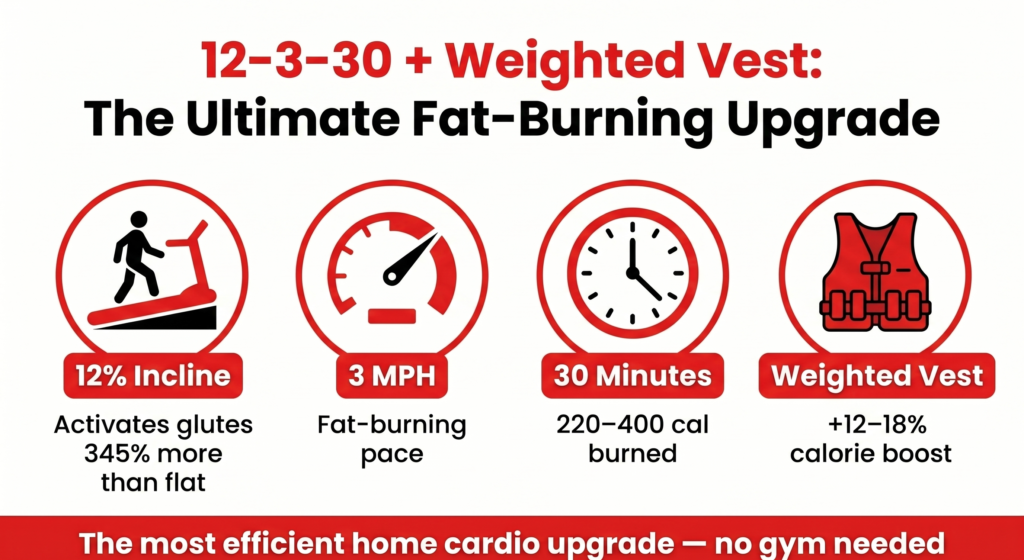
If you’ve spent any time on TikTok or Instagram in the last two years, you already know the 12-3-30. Popularized by influencer Lauren Giraldo, it is one of the most searched treadmill workouts in the world right now — and for good reason. The formula is almost insultingly simple:
- 12 = treadmill incline set to 12%
- 3 = walking speed of 3 miles per hour
- 30 = duration of 30 minutes
That’s it. No running, no complicated programming, no gym membership. Just steep, sustained incline walking that quietly destroys your posterior chain and cardiovascular system at the same time.
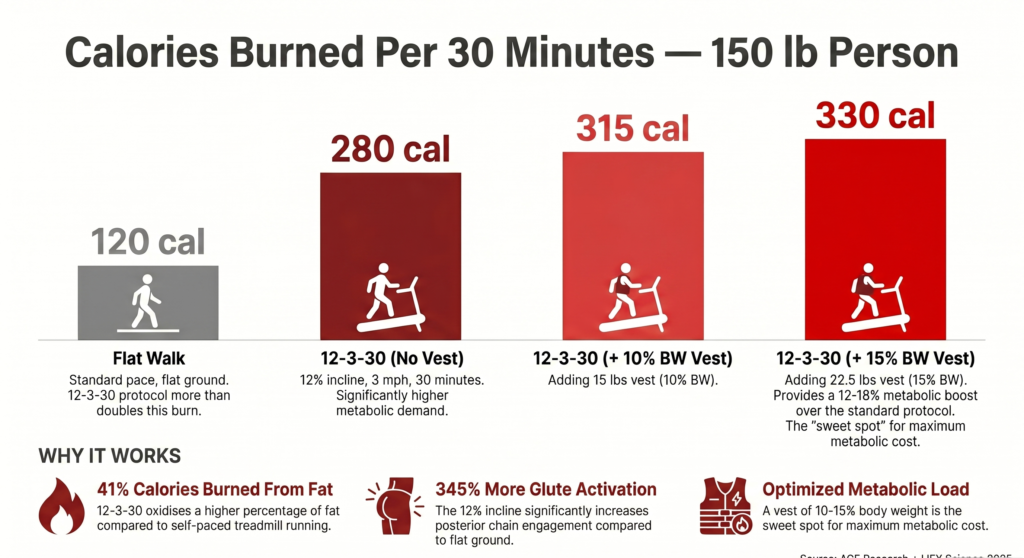
The science backs the hype. A 2025 peer-reviewed study published in the International Journal of Exercise Science found that 12-3-30 burned 41% of calories from fat, compared to just 33% during self-paced treadmill running — even when total calories burned were matched between the two workouts. Research from Western Colorado University found participants burned an average of 220 calories in a single 30-minute session, with heavier or less-fit individuals burning upwards of 300–400 calories.
But here’s the question nobody is asking yet:
What happens when you strap on a weighted vest and do it?
What Does a Weighted Vest Actually Do to Your Body? {#weighted-vest-science}
A weighted vest does one deceptively powerful thing: it makes your body think it weighs more. Every step, every muscle contraction, every heartbeat has to work against a higher load. The physics are unavoidable — more mass in motion demands more energy.
But the science is more nuanced than “heavier = better.”
In a landmark study commissioned by the American Council on Exercise (ACE) at the University of New Mexico, researchers tested untrained women walking at slow, graded speeds with varying vest weights. Their key findings:
- A vest equal to 15% of body weight increases calorie burn by approximately 12% compared to no vest at the same incline
- A vest equal to 10% of body weight at a 5–10% incline produces the greatest metabolic cost — around 13% more calories — making it the most efficient load-to-effort ratio
- Wearing a heavier vest beyond 15% body weight on a steep incline (like 12%) did not increase calorie burn further — because your biomechanics compensate
This is critical for 12-3-30 users. You’re already walking at 12% incline. Adding a vest of 10–15% of your body weight is the sweet spot that stacks metabolic demand without turning the workout into an injury risk.
A separate WHOOP-tracked study found that walking with a weighted vest burned 548 calories vs. 463 without — an 18% increase over an equivalent session. Research from the American College of Sports Medicine confirmed that adults walking at 3.0 mph (exactly the 12-3-30 pace) while wearing a vest equal to 20% of body weight burned 13% more calories than unloaded walkers.
The bottom line: a properly loaded vest turns a great workout into a significantly more productive one, at the exact speed and pace the 12-3-30 demands.
12-3-30 With a Weighted Vest: The Calorie Math {#calorie-math}
Let’s stop talking in percentages and do the actual math. The numbers below are estimates based on peer-reviewed research and vary by body weight, fitness level, and vest load.
Standard 12-3-30 Calorie Burn (No Vest)
| Body Weight | Calories Burned (30 min) |
|---|---|
| 130 lbs | ~200–240 calories |
| 150 lbs | ~250–300 calories |
| 170 lbs | ~280–340 calories |
| 200 lbs | ~320–400 calories |
12-3-30 With a Weighted Vest (10–15% Body Weight)
| Body Weight | Vest Weight | Estimated Calorie Increase | New Total (30 min) |
|---|---|---|---|
| 130 lbs | 13–20 lbs | +12–18% | ~224–283 calories |
| 150 lbs | 15–22 lbs | +12–18% | ~280–354 calories |
| 170 lbs | 17–25 lbs | +12–18% | ~314–400 calories |
| 200 lbs | 20–30 lbs | +12–18% | ~358–472 calories |
The compounding effect matters more than the single session. If you do 12-3-30 five days a week wearing a vest, and you burn an extra 40 calories per session (conservative estimate), that’s an extra 200 calories per week — or roughly 10,400 extra calories burned per year — purely from the vest addition. At a caloric deficit of 3,500 calories per pound of fat, that’s approximately 3 additional pounds of fat annually from one small equipment upgrade.
Related: If you want to understand how the 12-3-30 keeps you in the fat-burning zone, read our deep dive into Zone 2 cardio and why it’s the most underrated tool for home gym users. The 12-3-30 with a vest lands you squarely in this zone — and the vest keeps you there more efficiently.
Muscles Worked: What Changes When You Add Weight {#muscles-worked}
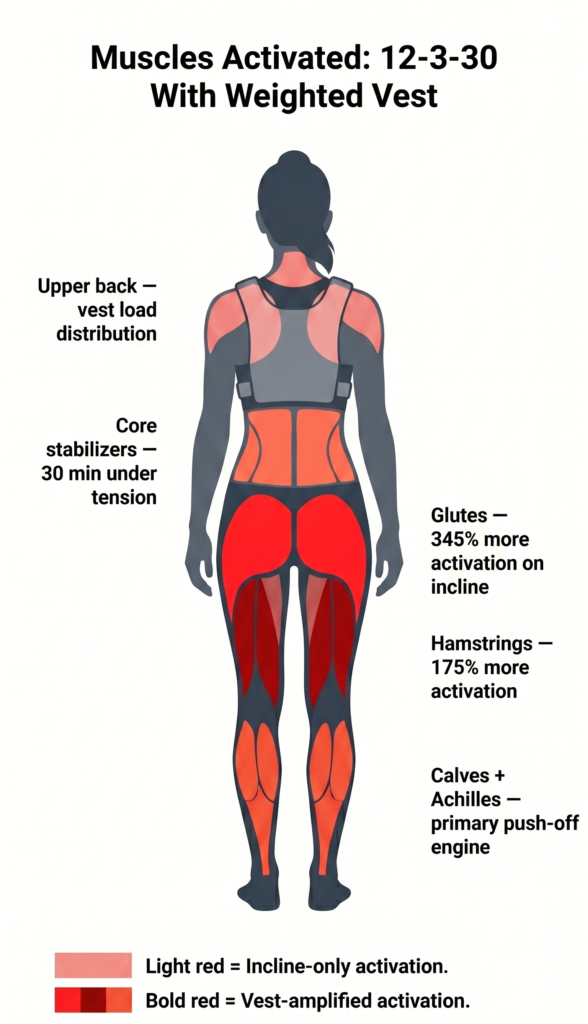
The 12-3-30 without a vest already does something impressive to your posterior chain. EMG (electromyography) research published in Gait and Posture found that glute activation increases by approximately 345% when walking on a steep incline compared to flat ground. Hamstring activation increases by approximately 175%.
That’s before you add a vest.
Here’s what the vest changes:
Glutes and Hamstrings
The incline already hammers these. The vest amplifies the load with each push-off stride. Your glutes have to work harder to extend the hip against both the incline angle and the additional downward force of the vest weight.
Core and Stabilizers
This is where the vest earns its keep. A weighted vest distributes load across your trunk, forcing your deep core stabilizers — transverse abdominis, multifidus, obliques — to work continuously throughout the walk. Flat-ground walking barely engages these. Incline walking engages them. Incline walking with a vest keeps them under tension for the full 30 minutes.
Calves and Achilles
The calf muscles and Achilles tendon are the engines of incline walking. They control the push-off phase and absorb the landing force. A vest adds load to this system — which is why proper progression is non-negotiable (more on this in the mistakes section).
Upper Back and Traps
A properly fitted vest rests on your shoulders and upper chest. Your upper traps and rear deltoids brace against this weight throughout the session. Over time, this contributes to improved posture — the opposite of what sitting at a desk all day does to you.
Cardiovascular System
The vest pushes your heart rate higher at the same speed and incline. Research found that 12-3-30 already puts most people in Zone 2 to Zone 3 (60–80% of max heart rate). The vest nudges you toward the upper end of that range, making cardiovascular adaptation happen faster. For a complete breakdown of why this heart rate zone is the most productive for fat loss and longevity, our Zone 2 cardio guide covers the research in detail.
Is 12-3-30 With a Weighted Vest Good for Weight Loss? {#weight-loss}
Yes — but not for the reason most people assume.
The fitness internet loves to fight over whether fat-burning percentage matters more than total calories. Here’s the honest answer: both matter, and the 12-3-30 with a vest optimizes both simultaneously.
Why the combo works for weight loss:
- Higher total calorie burn per session — the vest adds 12–18% more energy expenditure at a workload your body can sustain without burning out
- Higher fat oxidation percentage — the 2025 International Journal of Exercise Science study confirmed 41% fat utilization for 12-3-30, already above running. The vest keeps you in that intensity zone rather than pushing you out of it
- Preservation of muscle during a deficit — the mechanical load from the vest stimulates muscle retention, which protects your metabolic rate during fat loss
- Bone density stimulus — research from the Journal of Clinical Medicine found that weighted walking improves lower limb muscle power by 10–11% in women over 65, with bone density benefits linked to the compressive load
Performed 4–5 days per week alongside a moderate caloric deficit, 12-3-30 with a vest supports a sustainable weight loss rate of approximately 1–1.5 pounds per week.
Also worth reading: If you’re still deciding whether a treadmill or walking pad is the better investment for your home setup, our Walking Pad vs. Treadmill 2026 guide breaks down everything you need to know — including which models support 12% incline.
What Weight Vest Should You Use for 12-3-30? {#vest-weight}
The ACE research gives us a clear framework:
Target: 10–15% of your body weight
| Body Weight | Recommended Starting Vest Weight | Max Vest Weight |
|---|---|---|
| 120 lbs | 12 lbs | 18 lbs |
| 140 lbs | 14 lbs | 21 lbs |
| 160 lbs | 16 lbs | 24 lbs |
| 180 lbs | 18 lbs | 27 lbs |
| 200 lbs | 20 lbs | 30 lbs |
Practical vest-buying advice:
- Start with a fixed-weight vest in the 10–15 lb range if you’re new to weighted walking
- If you want to progress over time, invest in an adjustable weighted vest (available in 10–30 lb ranges) so you can add weight as fitness improves
- Fit matters enormously on an incline — choose a vest with a snug, low-movement design that sits close to your torso. A vest that bounces or shifts at every step will destroy your form
- Avoid heavy plate-carrier-style vests for treadmill work — they’re built for outdoor movement, not repetitive treadmill stride mechanics
Do not start at your maximum recommended weight. The Achilles tendon and calf complex need time to adapt to the added load of both the incline and the vest simultaneously. Start light and progress weekly.
How to Do 12-3-30 With a Weighted Vest: Beginner to Advanced {#how-to-do-it}
Setup
- Put on your weighted vest before stepping on the treadmill — you need to calibrate your posture before movement begins
- Set the treadmill to 12% incline and 3.0 mph
- Stand tall: shoulders back, chest open, core braced. The vest will try to pull you forward — resist it
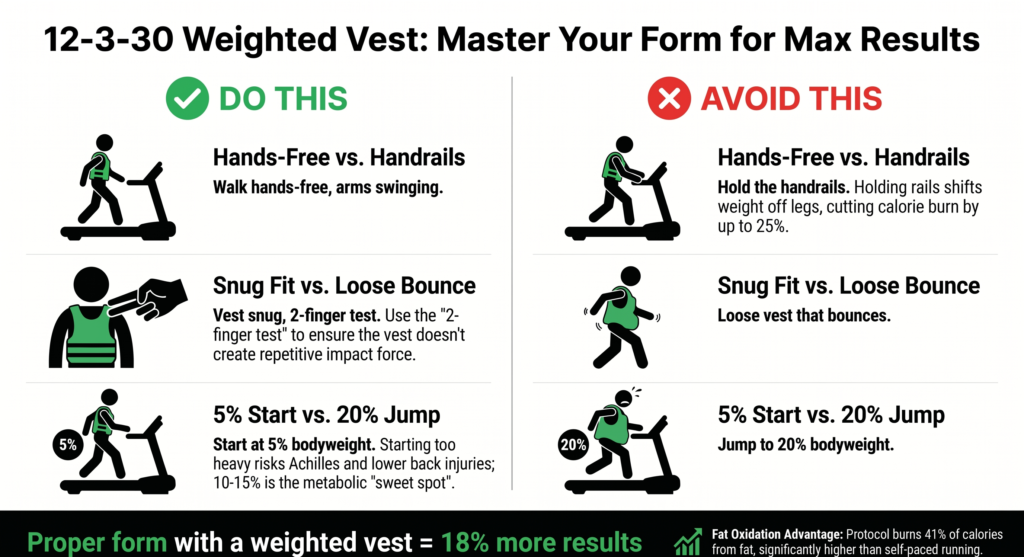
- Do not hold the handrails. This is a hard rule. Holding the rails reduces your body weight load and cuts your calorie burn significantly. If you need support, reduce the incline until you can walk hands-free
During the Walk
- Keep your gaze forward, not down at your feet
- Breathe rhythmically — in through the nose, out through the mouth
- Engage your glutes with each push-off stride
- Arms should swing naturally at your sides — the vest will add resistance to this movement
After the Walk
- Step off gradually — 12% incline + a weighted vest changes your center of gravity. Dismount carefully
- Stretch the calves, hip flexors, and hamstrings for a minimum of 5 minutes. The incline shortens these muscle groups and the vest adds to the load stress
- Take at least one full rest day between sessions in your first four weeks
The 4-Week 12-3-30 Weighted Vest Progressive Plan {#4-week-plan}
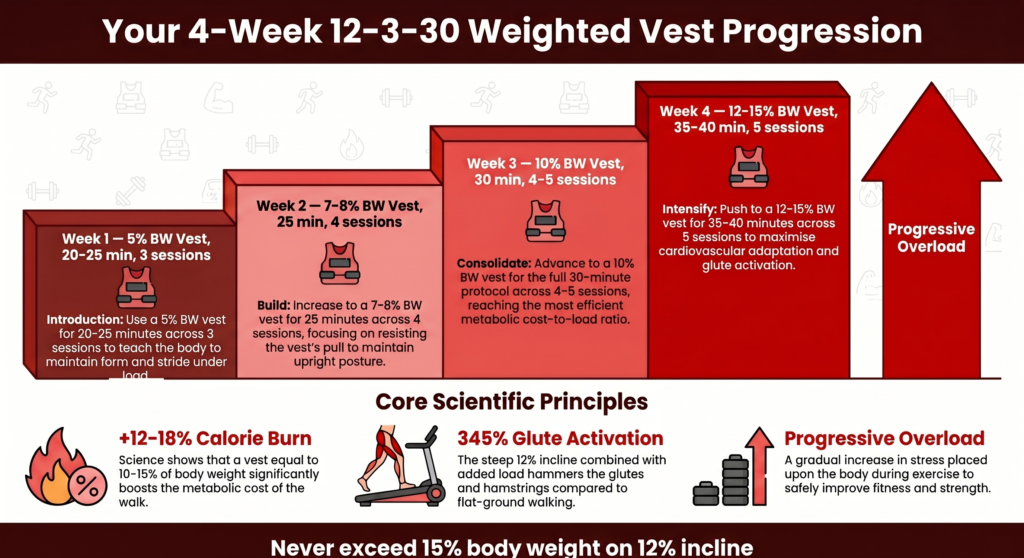
This plan assumes you’re comfortable doing standard 12-3-30 (without a vest) before adding load. If you’re new to 12-3-30 entirely, spend 2–3 weeks building the base workout first.
Week 1 — Introduction (5% Body Weight Vest)
Goal: Teach your body to maintain form and stride under load
| Day | Session | Incline | Speed | Duration | Vest Weight |
|---|---|---|---|---|---|
| Mon | Active | 12% | 3 mph | 20 min | 5% BW |
| Tue | Rest | — | — | — | — |
| Wed | Active | 12% | 3 mph | 20 min | 5% BW |
| Thu | Rest | — | — | — | — |
| Fri | Active | 12% | 3 mph | 25 min | 5% BW |
| Sat | Light walk | 6% | 2.5 mph | 20 min | No vest |
| Sun | Rest | — | — | — | — |
Key focus: Posture. The vest will want to pull your shoulders forward. Fight it.
Week 2 — Build (7–8% Body Weight Vest)
Goal: Extend duration and slightly increase load
| Day | Session | Incline | Speed | Duration | Vest Weight |
|---|---|---|---|---|---|
| Mon | Active | 12% | 3 mph | 25 min | 7–8% BW |
| Tue | Rest | — | — | — | — |
| Wed | Active | 12% | 3 mph | 25 min | 7–8% BW |
| Thu | Light walk | 8% | 2.5 mph | 20 min | No vest |
| Fri | Active | 12% | 3 mph | 30 min | 7–8% BW |
| Sat | Active | 12% | 3 mph | 25 min | 7–8% BW |
| Sun | Rest | — | — | — | — |
Week 3 — Consolidate (10% Body Weight Vest, Full Protocol)
Goal: Hit the full 12-3-30 protocol at the ACE-recommended vest load, 4–5x per week
| Day | Session | Incline | Speed | Duration | Vest Weight |
|---|---|---|---|---|---|
| Mon | Full 12-3-30 | 12% | 3 mph | 30 min | 10% BW |
| Tue | Rest | — | — | — | — |
| Wed | Full 12-3-30 | 12% | 3 mph | 30 min | 10% BW |
| Thu | Full 12-3-30 | 12% | 3 mph | 30 min | 10% BW |
| Fri | Rest | — | — | — | — |
| Sat | Full 12-3-30 | 12% | 3 mph | 30 min | 10% BW |
| Sun | Light walk | 6% | 2.5 mph | 20 min | No vest |
Week 4 — Intensify (12–15% Body Weight Vest or Extend Duration)
Goal: Push to the upper end of the ACE-recommended load range, or increase duration to 35–40 minutes
| Day | Session | Incline | Speed | Duration | Vest Weight |
|---|---|---|---|---|---|
| Mon | Extended 12-3-30 | 12% | 3 mph | 35 min | 12–15% BW |
| Tue | Rest | — | — | — | — |
| Wed | Extended 12-3-30 | 12% | 3 mph | 35 min | 12–15% BW |
| Thu | Full 12-3-30 | 12% | 3 mph | 30 min | 12–15% BW |
| Fri | Rest | — | — | — | — |
| Sat | Extended 12-3-30 | 12% | 3 mph | 40 min | 12–15% BW |
| Sun | Recovery walk | 5% | 2.5 mph | 20 min | No vest |
Pro tip: After Week 4, you can either increase vest weight incrementally (by 2–4 lbs every 3–4 weeks) or stack the protocol with bodyweight strength training on rest days. If you’re unsure how to build a full home workout routine around this, check out our Is a Home Gym Worth It? guide to see how a simple setup can support a complete training program.
Common Mistakes That Kill Your Results {#mistakes}
1. Starting Too Heavy
The most common error. A vest equal to 20–30% of body weight on a 12% incline creates dangerous levels of stress on the Achilles tendon, plantar fascia, and lower back. Research found these are the injury sites most commonly affected when progression is too aggressive. Start at 5% body weight, not 20%.
2. Holding the Handrails
This is the silent killer of the 12-3-30. Holding the rails shifts your effective body weight forward, takes load off your legs, reduces core engagement, and cuts calorie burn — some research suggests by as much as 20–25%. The vest is useless if you’re leaning on the machine. If you can’t let go, reduce the incline until you can.
3. Looking Down
The incline on a treadmill creates a natural pull toward looking at your feet. Resist it. Looking down flexes the cervical spine and causes the vest weight to distribute unevenly across your upper back, leading to neck and shoulder fatigue rather than productive load-bearing.
4. Skipping the Post-Walk Stretch
The combination of a 12% incline and weighted vest places repeated eccentric stress on the calf-Achilles complex. Without proper post-session stretching, this accumulates into overuse injury within 2–3 weeks for most people. Five minutes of calf stretches, hip flexor work, and hamstring holds after every session is non-negotiable.
5. Wearing the Vest Too Loose
A loose vest bounces with every step. On a treadmill, this creates a repetitive impact force on your spine and shoulders that has nothing to do with productive training stimulus. Cinch the vest snugly before stepping on the machine. You should be able to fit two fingers under the straps — but not a fist.
6. Doing It Every Single Day
The 12-3-30 with a vest is more demanding than it looks. The Achilles tendon and plantar fascia in particular need 24–48 hours of recovery between sessions, especially in the first month. Limit sessions to 4–5 days per week maximum and include at least one full rest day between back-to-back sessions.
Frequently Asked Questions
Does wearing a weighted vest on 12-3-30 actually burn more calories?
Yes — and the science is clear on this. ACE-commissioned research found that walking with a vest equal to 10–15% of your body weight increases calorie burn by 12–18% compared to the same walk unloaded. At the 12-3-30 speed of 3 mph, this means burning an additional 30–60 calories per session depending on your body weight. Over a month of consistent training, this compounds to a meaningful extra caloric deficit.
How many calories does 12-3-30 burn with a weighted vest?
At 150 lbs with a 15–22 lb vest: approximately 280–354 calories per 30-minute session. At 170 lbs with a 17–25 lb vest: approximately 314–400 calories. These estimates are based on ACE research and metabolic studies on incline walking with added load. Individual results vary based on fitness level and effort.
What weight vest should I use for 12-3-30?
Start with 5–8% of your body weight for the first 1–2 weeks. Progress to 10% of your body weight once your posture and stride are stable with the vest on. The maximum productive load for incline walking at this grade is 15% of body weight — beyond that, the ACE study found no additional metabolic benefit, and injury risk increases.
Is 12-3-30 with a weighted vest good for building glutes?
It is better than standard 12-3-30, yes. EMG research found glute activation increases 345% on a 12% incline vs. flat walking. The vest adds mechanical resistance to each push-off stride, amplifying the stimulus to the glutes and hamstrings. However, for significant glute hypertrophy, you should combine this with dedicated resistance training (hip thrusts, Romanian deadlifts, squats). The 12-3-30 with vest is excellent for tone, conditioning, and endurance of the glutes — not mass building on its own.
Can I do 12-3-30 with a weighted vest every day?
Not recommended, especially in the first four weeks. The Achilles tendon and calf complex are under significant stress from the combination of a 12% incline and added vest weight. Daily performance increases overuse injury risk substantially. Four to five sessions per week with at least one rest day between back-to-back sessions is the safe and effective limit.
Is 12-3-30 with a weighted vest better than running?
For most home gym users: yes, practically speaking. The 2025 International Journal of Exercise Science study confirmed that 12-3-30 burns a higher percentage of calories from fat than running (41% vs. 33%). Running burns calories faster per minute — but 12-3-30 with a vest is low-impact, sustainable five days per week, buildable via progressive overload, and requires only a treadmill or walking pad. Running offers greater cardiovascular adaptation at higher intensities. The ideal approach is to use the 12-3-30 with vest as your primary cardio base (particularly in Zone 2), and add Zone 3–4 intervals separately when your fitness level warrants it.
Can I do the 12-3-30 with a walking pad instead of a treadmill?
Yes — with an important caveat. Your walking pad must support at least 10–12% incline, and the motor must be rated for sustained load-bearing walking (look for motors rated 2.5 HP or higher). Walking pads that only support flat walking are not suitable for this protocol. Our Walking Pad vs. Treadmill guide covers which models support this workout specifically.
Should I hold the treadmill during 12-3-30 with a weighted vest?
Absolutely not. Holding the handrails significantly reduces calorie burn by shifting your body weight onto your arms rather than your legs, reduces core activation, and defeats a major purpose of the vest. If you cannot complete the protocol without holding on, reduce the vest weight or lower the incline to a level where you can walk hands-free with confident form.
Will 12-3-30 with a weighted vest help with belly fat?
There is no exercise that spot-reduces fat from a specific area — the research is clear on this. However, the 12-3-30 with a vest creates a significant caloric deficit over time, burns a high percentage of fat as fuel, and preserves muscle mass during a deficit — all of which contribute to full-body fat loss including the abdominal area. Pair it with a moderate caloric deficit and adequate protein, and it becomes a potent fat loss tool.
How 12-3-30 With a Weighted Vest Compares to Japanese Walking
The other major home cardio trend of 2026 is Japanese Walking — also known as interval walking training, which alternates 3 minutes of fast walking with 3 minutes of slow walking for 30 minutes. Both are low-impact, no-equipment-required (aside from a treadmill), and science-backed.
Here’s how they compare:
| Factor | 12-3-30 + Vest | Japanese Walking |
|---|---|---|
| Calorie burn (30 min) | 280–470 calories | 200–320 calories |
| Fat oxidation | Very high (Zone 2–3) | High (Zone 2) |
| Posterior chain work | Intense | Moderate |
| Cardiovascular adaptation | Strong aerobic base | Improved VO2max via intervals |
| Equipment needed | Treadmill/walking pad with incline | Any flat surface |
| Joint impact | Low–moderate | Very low |
| Best for | Fat loss + muscle tone | Cardiovascular health + blood sugar control |
If your goal is maximum fat loss and lower body conditioning in a home gym setup, 12-3-30 with a weighted vest wins. If your priority is pure cardiovascular health and blood sugar management with zero equipment, Japanese Walking is the superior option. Many home gym athletes use both in rotation — 12-3-30 with vest three days a week, Japanese Walking on active recovery days.
Final Verdict: Is 12-3-30 With a Weighted Vest Worth It? {#verdict}
Without question.
The 12-3-30 is already one of the most efficient, low-impact fat-burning workouts you can do at home. Adding a weighted vest — at the correct load — is the single most effective way to progress it without increasing injury risk, changing the simplicity of the protocol, or requiring a second piece of equipment.
The science supports three clear outcomes from consistent use:
- 12–18% more calories burned per session — compounding to meaningful fat loss advantage over weeks and months
- Greater posterior chain activation — better glute, hamstring, and core conditioning than the standard protocol
- Maintained Zone 2 heart rate range — keeping you in the fat-burning aerobic zone as your fitness improves and the standard 12-3-30 becomes less challenging
The rule is simple: start with 5% of your body weight, progress to 10–15% over four weeks, never hold the rails, and never skip the post-session stretch.
Your living room, bedroom, or garage can be the site of your best cardio training. You do not need a commercial gym. You need a treadmill, a vest, and thirty minutes.
That is the whole story.
Key Takeaways
- The 12-3-30 workout (12% incline, 3 mph, 30 min) burns 41% of calories from fat — more than running
- Adding a weighted vest equal to 10–15% of body weight increases calorie burn by 12–18% per session
- Start at 5% body weight and progress over 4 weeks; never exceed 15% body weight on a 12% incline
- Never hold the handrails — it negates the vest’s benefits
- Stretch the calves, hip flexors, and hamstrings for at least 5 minutes after every session
- 4–5 sessions per week is optimal; daily performance increases overuse injury risk
- Combine with Zone 2 cardio training for maximum fat-burning adaptation
Have you tried 12-3-30 with a weighted vest? Drop your experience in the comments. We read every single one.
Sources:
- Wong et al. (2025). An Exploratory Study Comparing the Metabolic Responses between the 12-3-30 Treadmill Workout and Self-Paced Treadmill Running. International Journal of Exercise Science.
- Kravitz, L. et al. ACE-Commissioned Study: The Metabolic Cost of Slow Graded Treadmill Walking With a Weighted Vest. University of New Mexico / ACE.
- Research published in the Journal of Biomechanics on incline calorie burn vs. flat walking.
- Gait and Posture EMG study on posterior chain activation during incline walking.
- Journal of Clinical Medicine study on weighted vest training and lower limb muscle power.
- Seth Higgins et al. (2025). The effect of incline walking on lower extremity and trunk mechanics. Sports Medicine and Health Science.