
If you spend any time on fitness social media in 2026, you’ve seen the phrase everywhere: Japanese walking. The hashtag #JapaneseWalking has millions of views, with people trading steady-state strolls for something that looks almost too simple to work — alternating bursts of brisk walking with slower recovery periods. But this isn’t just a viral dance or a quick-fix gimmick. It’s a research-backed exercise method developed in Japan that requires zero equipment, takes just 30 minutes, and can be done in your living room, on a walking pad, or around your neighborhood. Originating from two decades of studies at Shinshu University, Japanese walking — officially called Interval Walking Training (IWT) — is quietly reshaping how we think about low-impact cardio. Here’s exactly what it is, why it works, and how you can use it to transform your fitness from home.
Use the free Japanese walking calculator below to get your
personalised IWT results — including calories burned per session,
your zone 2 heart rate range, and walking pad speed targets based
on your age and weight.
Japanese Walking Calculator
Get your personalised zone 2 heart rate, calories burned per IWT session, and walking pad speed targets.
Calculated using the Tanaka formula (208 − 0.7 × age), which is more accurate than the standard 220 − age method. Max HR: — bpm.
These are starting points — adjust by 0.5 km/h until the fast pace feels like you can speak in short sentences but not sing.
Projections assume a full 40-minute IWT session (5-min warm-up, 5 cycles, 5-min cool-down) each time.
Calorie estimates use MET-based equations from the ACSM compendium of physical activities.
Individual results vary. Always consult your doctor before starting a new exercise programme.
Learn more about Japanese walking and IWT at AnyRoomGym.com
Your zone 2 heart rate is the target to stay within during the
slow recovery intervals of Japanese walking. The fast intervals
push you to around 70% of your maximum heart rate — the exact
intensity used in the Shinshu University IWT studies. If you’re
using a walking pad, the speed targets above are a starting point;
adjust by 0.5 km/h until the fast pace feels challenging but
conversational.

What Is Japanese Walking?
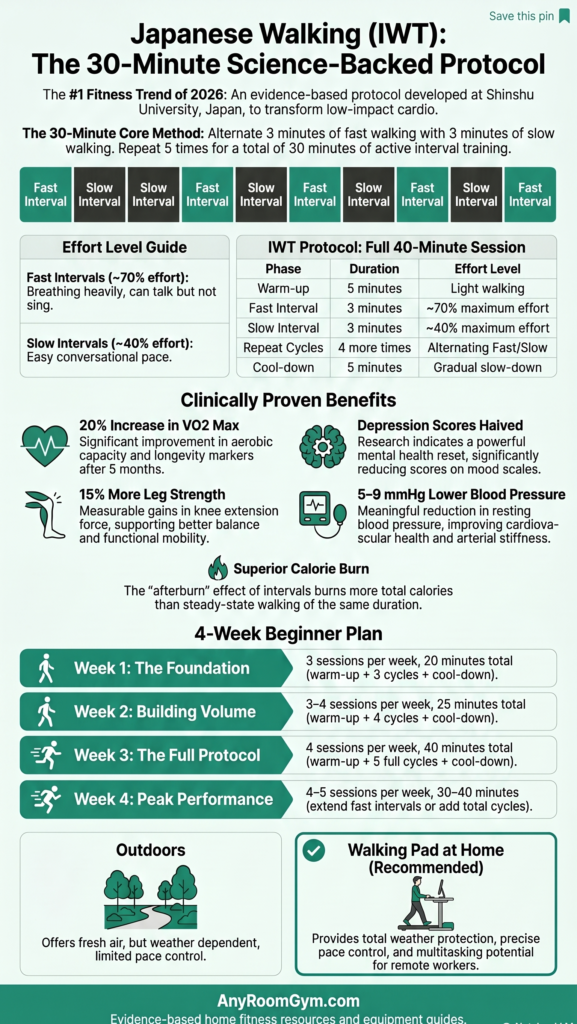
Japanese walking, formally known as Interval Walking Training (IWT), is a structured walking workout that repeats cycles of fast walking and slow walking. The classic protocol: 3 minutes of fast walking followed by 3 minutes of slow walking, repeated for 5 cycles — for a total of 30 minutes (plus warm-up and cool-down). Developed by researchers at Shinshu University in Japan, IWT deliberately stresses your cardiovascular system during the fast intervals and lets you recover during the slow intervals, creating an interval training effect that’s far more potent than a casual walk.
The protocol at a glance:
| Phase | Duration | Effort level |
|---|---|---|
| Warm up | 5 minutes | Light walking |
| Fast interval | 3 minutes | ~70% of your maximum effort (you can talk but not sing) |
| Slow interval | 3 minutes | ~40% effort (easy conversational pace) |
| Repeat fast/slow | 4 more cycles | Same structure |
| Cool-down | 5 minutes | Light walking, gradual slow-down |
| Total session | 30–40 minutes |
Even though it feels gentle, each fast interval pushes you into a zone where your heart and lungs adapt rapidly — exactly the kind of stimulus that improves VO2 max, lowers blood pressure, and builds stamina. And because walking is low-impact, almost anyone can do it.
The Science Behind Japanese Walking
This isn’t a TikTok trend that appeared overnight. Shinshu University researchers, led by Professor Hiroshi Nose and later Dr. Shizue Masuki, have been studying interval walking since the early 2000s. Their landmark studies followed thousands of middle-aged and older adults for years, comparing IWT to continuous moderate walking.
The numbers they published are remarkable:
- Aerobic capacity (VO2 max) increased by approximately 20% after 5 months of IWT, while the steady-walking group saw minimal change.
- Resting blood pressure dropped by an average of 5–9 mmHg in the IWT group — a clinically meaningful reduction.
- Leg strength improved by roughly 15%, measured by knee extension force.
- Depression scores were halved in participants who stuck with the protocol, according to mood scales used in the research.
A 2024 review published in Applied Physiology, Nutrition, and Metabolism confirmed that interval walking outperforms steady-state walking for cardiovascular fitness, insulin sensitivity, and body composition — and does so with greater time efficiency. The mechanism is simple: short, repeated bursts of higher intensity stimulate mitochondrial growth in muscle cells and improve the heart’s pumping ability without the joint stress of running.
As exercise physiologist Dr. Emily Harrison explains, “Interval walking, when done correctly, can raise your VO2 max by up to 15% in just a few months — no running required. That translates directly into living longer and better.” That’s a powerful statement for a workout you can do in your pajamas before breakfast.
Japanese Walking Benefits, What Happens to Your Body
Burns more calories than regular walking
By elevating your heart rate during the fast intervals, Japanese walking pushes your metabolism higher than a steady stroll. The alternating intensity creates an “afterburn” effect where you continue burning extra calories post-walk — making it an efficient walking for weight loss tool without the hunger spikes intense running can cause.
Improves cardiovascular fitness (VO2 max)
Your VO2 max — the maximum amount of oxygen your body can use during exercise — is one of the strongest predictors of longevity. IWT repeatedly challenges your aerobic system at 70% of max effort, and research shows that over weeks, your heart, lungs, and muscles adapt by becoming more efficient. This is true zone 2 cardio work that builds a robust engine.
Builds leg strength
Contrary to what many assume, walking — when done in fast intervals — can significantly strengthen your quads, hamstrings, and glutes. The Shinshu University studies documented measurable increases in leg extension power, which translates into better balance and functional fitness as you age.
Lowers blood pressure naturally
Blood pressure walking research indicates that IWT reduces both systolic and diastolic pressure, likely due to improved endothelial function and reduced arterial stiffness. Many participants saw BP drops comparable to what some medications achieve, making it a powerful adjunct (but not a replacement) to medical care.
Mental health benefits — depression scores
In multiple trials, IWT participants reported substantial improvements in mood and a reduction in depression scores that remained even after the study period. The combination of rhythmic movement, controlled breathing, and outdoor or mindful indoor walking appears to act as a potent mental reset.
How to Do Japanese Walking (Interval Walking Training)
Japanese Walking, also called Interval Walking Training (IWT), alternates 3 minutes of fast walking with 3 minutes of slow walking for 5 cycles, totalling 30 minutes. Developed at Shinshu University in Japan, this protocol requires no equipment and can be done outdoors or on a walking pad at home.
PT40M
Warm Up with Easy Walking
Walk at a slow, comfortable pace for 5 minutes to loosen your joints and settle your breathing. If you are on a walking pad, set the speed to 2.5–3 km/h (1.5–1.8 mph). Do not skip this step — jumping straight into fast intervals increases injury risk.
Walk Fast for 3 Minutes (70% Effort)
Increase your pace to approximately 70% of your maximum effort. You should be breathing heavily but still able to speak in short sentences — not gasping. On a walking pad, this is typically 5.5–7 km/h (3.4–4.3 mph) depending on your fitness level. Swing your arms and walk with purpose.
Walk Slow for 3 Minutes (40% Effort)
Drop back to an easy stroll at approximately 40% effort. Let your heart rate come down and breathe through your nose if possible. This is active recovery — keep moving, do not stop. On a walking pad, reduce speed to 2.5–3 km/h. This recovery phase is what makes the next fast interval possible.
Repeat Fast and Slow Intervals for 5 Total Cycles
Return to the fast interval (Step 2) and repeat the full fast-slow cycle four more times for 5 total cycles (30 minutes of intervals). Use a phone timer, smartwatch interval alert, or a free Japanese walking timer app to track each 3-minute segment automatically. Most people find cycles 3 and 4 the hardest — push through and cycle 5 becomes easier.
Cool Down with 5 Minutes of Easy Walking
After your 5th slow interval, gradually reduce your pace over 5 minutes until you reach a very slow stroll. Finish by standing still and performing light leg stretches — quad stretch, calf stretch, and hip flexor stretch. This prevents blood pooling in the legs and accelerates recovery for your next session.
Use a timer on your phone, a smartwatch with interval alerts, or a free app like Interval Timer. No need to guess. If you prefer to do your intervals indoors, check out our guide to the best walking pads for zone 2 cardio — they let you control speed precisely and never miss a session due to weather.
Watch: Follow Along With a Full 30-Minute Session
Japanese Walking on a Walking Pad vs. Outdoors
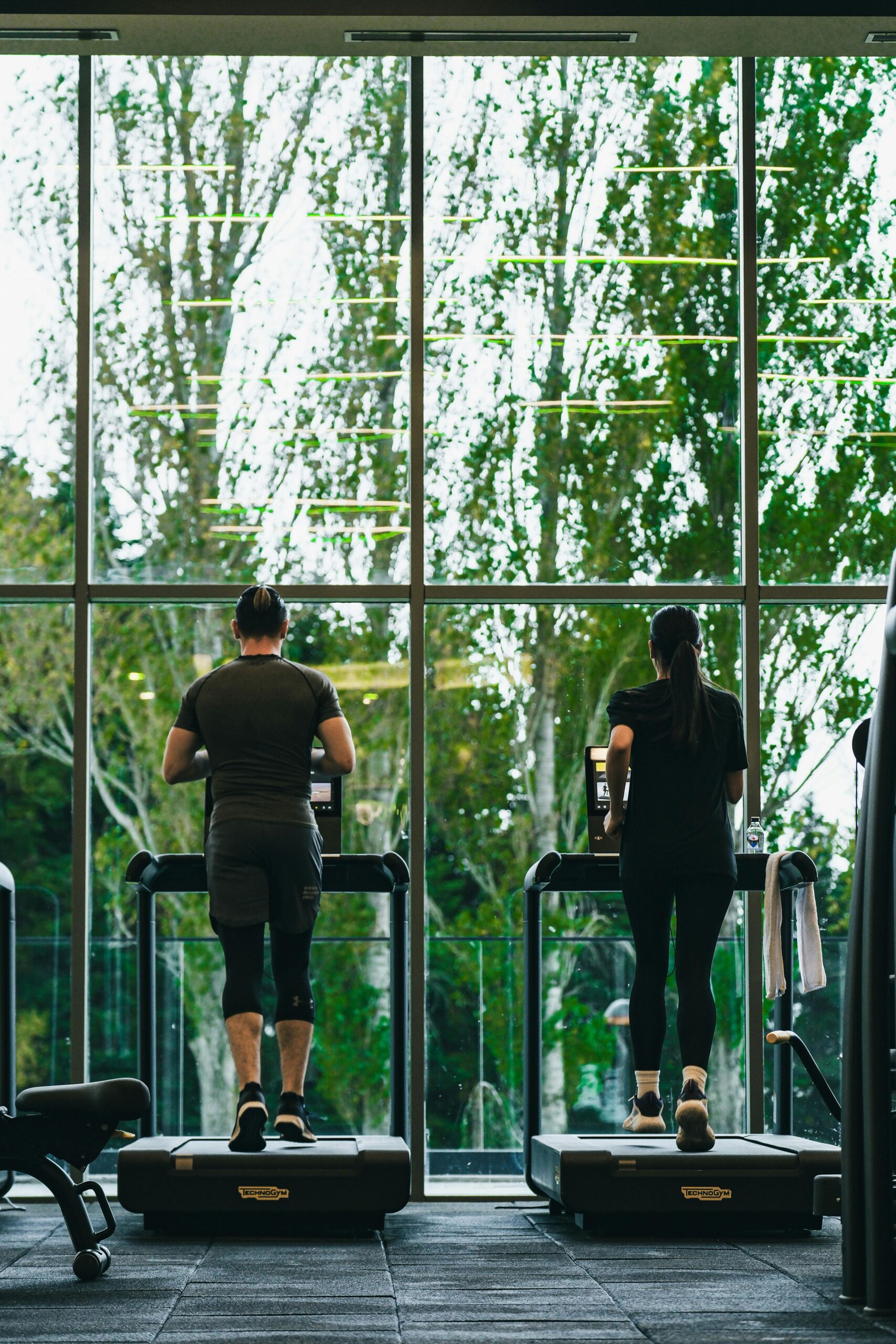
You can absolutely do Japanese walking outside, but a walking pad (an under-desk treadmill without handles) brings unique advantages to a home gym.
- Weather-proof: Rain, snow, or blazing heat won’t interrupt your streak.
- Pace control: Digital speed settings eliminate the guesswork. You know exactly how fast your fast intervals are, and you can increase the challenge incrementally.
- Incline option: Many walking pads now let you add a slight incline, mimicking the hilly terrain in the Japanese studies that further amplified leg strength gains.
- Multitasking: If you’re a remote worker, a walking pad under a standing desk lets you do a full IWT session while catching up on emails during the slow intervals.
Outdoors has its own charm — varied scenery, fresh air, and vitamin D. The best choice is the one you’ll stick with. If you’re building a complete home gym setup, a quality walking pad earns its footprint fast because it’s the cardio machine you’ll use daily without dreading it.
4-Week Japanese Walking Plan for Beginners
Start here. This plan assumes you can walk comfortably for 20 minutes. Listen to your body and adjust.
- Week 1: 3 sessions per week, each 20 minutes total (warm-up, 3 fast/slow cycles, cool-down). Focus on learning the effort levels — don’t stress about speed.
- Week 2: 3–4 sessions, 25 minutes total. Add a 4th cycle. Fast intervals can feel “challenging but controlled.”
- Week 3: 4 sessions, 30 minutes (5 full cycles). This is the full dose that produced the research gains.
- Week 4: 4–5 sessions, 30–40 minutes. Optionally extend fast intervals to 3.5 minutes or increase your fast-pace speed slightly. Always keep the slow interval a true recovery.
A crucial note: walking alone isn’t sufficient for significant muscle gain or bone density improvement. You’ll get far better results if you pair your Japanese walking sessions with a simple dumbbell strength routine twice a week. The combination of low-impact intervals and resistance training builds a resilient, balanced body.
What to Eat Around Your Japanese Walking Sessions
Fueling for IWT doesn’t need to be complicated. Most home-gym users do these sessions in the morning or during a work break.
- Pre-walk (30–60 minutes before): A small source of easily digestible carbs like a banana or a rice cake gives fast-interval energy without stomach slosh. If you’re walking first thing upon waking, a few sips of water might suffice.
- Post-walk: Aim for 20–30 grams of protein within an hour to support muscle repair — a scoop of whey protein, a Greek yogurt with berries, or two scrambled eggs on toast. This is particularly important if you’re pairing walking with strength sessions.
- Hydration: Even a 30-minute interval walk can dehydrate you, especially indoors with less airflow. Sip water before and after; if you sweat heavily, a pinch of salt in your water or an electrolyte tab helps.
For a full breakdown of nutrition for home workouts, our home gym nutrition guide covers meal timing, supplements, and real-food strategies that complement interval training.
Japanese Walking vs. Other Popular Walking Workouts
How does Japanese walking stack up against other viral walking routines? Here’s a quick comparison to help you decide what fits your day.
| Workout | Duration | Equipment | Cardio Benefit | Difficulty |
|---|---|---|---|---|
| Japanese Walking (IWT) | 30–40 min | None (treadmill/walking pad optional) | High – builds VO2 max, proven in studies | Moderate – effort-based, scalable |
| 12-3-30 | 30 min | Treadmill only | Moderate – steady incline power walk | Strenuous – continuous high incline |
| Hot Girl Walk | 60 min outdoors | None | Low to moderate – steady-state, mood-focused | Low – social, low-intensity |
| 6-6-6 Walking Challenge | 60 min | None | Moderate – steady with short warm/cool | Low to moderate – consistency over intensity |
| Zone 2 steady walking | 45–60 min | None or walking pad | Moderate – aerobic base building | Low – long, steady effort |
Japanese walking’s advantage is efficiency and the science behind the specific 3-minute interval ratio. While zone 2 walking builds a solid aerobic base over longer sessions, IWT adds the intensity punch that traditional walking lacks — in a time frame anyone can protect.
Who Should Try Japanese Walking?
Beginners: You can walk. You can speed up for 3 minutes. This is the most approachable entry point to interval training, with no complex movement patterns to learn.
Remote workers and desk-sitters: A walking pad under a standing desk plus a timer app is the ultimate antidote to long sedentary hours. Break up your morning with a 30-minute session that leaves you energized, not exhausted.
Older adults: The Shinshu University studies primarily recruited people aged 40 to 80. The protocol proved safe and effective for improving balance, leg strength, and cardiovascular health — all while being gentle on joints.
Anyone managing blood pressure or blood sugar: IWT’s ability to lower resting blood pressure and improve insulin sensitivity makes it a powerful lifestyle tool. Always consult your doctor, but many physicians actively prescribe walking intervals for these conditions.
People returning from injury: Low-impact, no jumping, no jarring. Japanese walking can be dialed down as needed and is often used as a bridge back to fitness after knee, hip, or lower-back issues.
Anyone bored of their current cardio routine: If the thought of another elliptical session puts you to sleep, the fast/slow switching keeps your mind engaged and the clock moving fast.
Common Mistakes to Avoid
- Skipping the warm-up: Jumping straight into fast intervals tightens muscles and spikes heart rate dangerously. Always ease in.
- Going too hard on fast intervals: If you’re sprinting or unable to speak, you’ve overshot the 70% zone. IWT is not all-out HIIT; it’s controlled vigorous effort.
- Ignoring slow recovery phases: The magic happens when you let your heart rate drop. A slow walk, not a standstill, keeps blood flow active and sets you up for the next interval.
- Doing it every day without rest: 4–5 sessions per week is the ceiling for most people. Muscles and the nervous system need recovery days to adapt.
- Wearing unsupportive shoes: Even low-impact walking can cause foot and shin issues with flimsy footwear. Use a well-cushioned walking or running shoe.
- Stopping too early: Many beginners quit after 2 cycles because they feel winded. Push through the first two — your body adapts, and the third and fourth intervals often feel easier.
Final Thoughts
Japanese walking strips away every barrier to getting fit. It’s free, requires no equipment you don’t already have, and takes just 30 minutes. The fact that it’s backed by more than 20 years of rigorous research — showing real changes in your heart, lungs, legs, and mind — makes it something rare: a viral trend that deserves its spotlight. You can step onto a walking pad in your apartment at 7 a.m. and finish before your coffee’s cold, or walk around the block with a timer and return home energised.
Start with Week 1 today. Keep your fast intervals honest but not manic, and let the slow recoveries reset you. The people in the Shinshu studies were often in their 60s and 70s; if they can improve their VO2 max by 20%, so can you. And once you feel the rhythm of those 3-minute cycles, you might never go back to mindless plodding.
If you’re ready to take your home training further, expand your home gym with the right equipment — a solid walking pad, a pair of adjustable dumbbells, and a simple setup can keep you progressing for years. But for now, all you truly need is a timer, a little space, and the willingness to walk fast for three minutes at a time. That’s the elegant secret of Japanese walking.
Why Trust Us: At AnyRoomGym.com, every article is rooted in peer-reviewed research and real-world testing. Our team includes certified personal trainers, nutrition coaches, and home-gym veterans who obsess over the details so you get advice that actually works, no fluff. We’ve spent hundreds of hours reviewing equipment and protocols — this Japanese walking guide is built on the same Shinshu University studies we’d follow ourselves.
FREQUENTLY ASKED QUESTIONS
What is Japanese walking?
Japanese walking, or Interval Walking Training (IWT), is a scientifically proven cardio method that alternates 3 minutes of fast walking with 3 minutes of slow walking for 5 cycles. Developed at Shinshu University, it improves aerobic capacity and cardiovascular health in just 30 minutes a day.
How is Japanese walking different from regular walking?
Regular walking maintains a steady pace, while Japanese walking repeatedly pushes your heart rate up during fast intervals and brings it down during recovery. This interval structure boosts VO2 max, calorie burn, and leg strength far more than a constant moderate walk.
How is Japanese walking different from regular walking?
Regular walking maintains a steady pace, while Japanese walking repeatedly pushes your heart rate up during fast intervals and brings it down during recovery. This interval structure boosts VO2 max, calorie burn, and leg strength far more than a constant moderate walk.
Can Japanese walking help with weight loss?
Yes, by elevating your metabolism both during and after the workout. The afterburn effect from the fast intervals helps you burn more total calories than steady walking of the same duration, especially when combined with a sensible nutrition plan.
How many minutes should Japanese walking last?
A full session including warm-up and cool-down lasts 30 to 40 minutes. The core interval portion is exactly 30 minutes (5 fast-slow cycles of 3 minutes each), with 5 minutes of warm-up and 5 minutes of cool-down recommended.
Can I do Japanese walking on a treadmill or walking pad?
Absolutely. A treadmill or walking pad is ideal because you can precisely set speeds for fast and slow intervals and maintain consistency regardless of weather. Many indoor walkers find it easier to track progress and add slight incline for extra challenge.
Is Japanese walking a HIIT workout?
Japanese walking is a form of low-impact interval training that shares HIIT’s cardio benefits, but it’s gentler. Fast intervals are performed at around 70% effort rather than all-out sprints, making it safer for joints and accessible to a wider range of ages and fitness levels.
Do I need any equipment for Japanese walking?
No equipment is required. The protocol can be done outdoors with comfortable walking shoes and a timer. Indoors, a walking pad or treadmill is helpful but optional. A smartwatch or phone interval timer simplifies tracking the 3-minute segments.
Who created Japanese walking?
Interval Walking Training was developed by researchers at Shinshu University in Japan, led by Professor Hiroshi Nose. Over two decades of studies, the team proved that 3-minute fast-slow intervals yield dramatic improvements in fitness and health markers for middle-aged and older adults.