
Most zone 2 calculators stop at heart rate. They tell you to stay between 114 and 133 bpm — and leave you staring at your walking pad wondering what speed that actually means. This page fills that gap. The free calculator above takes your age, resting heart rate, fitness level, and incline setting and gives you the exact speed to dial in, a full five-zone heart rate breakdown, and an incline table so you can hit zone 2 whether your walking pad maxes out at 4 mph or 7 mph. Below the calculator, this guide covers everything else you need to know — what zone 2 actually does to your body, how long sessions need to be, the mistakes that keep most walkers stuck in zone 3 without realising, and answers to every question people search on this topic.
"Use the free zone 2 walking speed calculator below — enter your age, resting heart rate, fitness level, and incline — and get your exact speed target, heart rate zone, and a personalised session plan in seconds."
Zone 2 Walking Speed Calculator
Enter your details and get the exact speed to set on your walking pad or treadmill to stay in zone 2 — with incline adjustments, heart rate targets, and a personalised session plan.
Calculated using the Tanaka formula (208 − 0.7 × age) combined with the Karvonen method using your resting heart rate — more accurate than the basic 220 − age method for trained individuals.
Higher incline means you hit zone 2 at a lower speed — useful for walking pads with a max speed of 6 km/h.
| Incline | Speed (km/h) | Speed (mph) | Notes |
|---|
Heart rate formulas are estimates. Individual variation is normal — always use the talk test alongside any calculator.
If you take medication that affects heart rate, consult your doctor before training by heart rate zones.
Built by AnyRoomGym.com — home gym guides, walking pad reviews, and free training tools.
What is zone 2 cardio and why does it matter for walking?
Zone 2 is the aerobic training zone where your heart rate sits at 60–70% of its maximum. At this intensity your body burns primarily fat for fuel, your breathing is elevated but controlled, and you can hold a full conversation — though it takes a little effort. It is not a stroll and it is not a workout that leaves you sweating through your shirt. It sits deliberately in the middle, and that is precisely what makes it powerful.The physiological reason zone 2 matters comes down to mitochondria — the energy-producing structures inside your muscle cells. Zone 2 intensity is the training stimulus that most effectively increases mitochondrial density and function. More mitochondria means your body becomes more efficient at using oxygen and burning fat, both during exercise and at rest. This is why endurance athletes spend 70–80% of their total training volume in zone 2. It is not because they lack ambition — it is because decades of research confirm it builds the aerobic engine that everything else runs on.For walking pad and treadmill users specifically, zone 2 solves a common frustration: people who walk at a comfortable pace but never see meaningful cardiovascular progress. A leisurely 2 mph stroll keeps your heart rate in zone 1 — too easy to drive adaptation. Zone 2 walking is the precise step up that produces real, measurable results without the recovery cost of harder training.
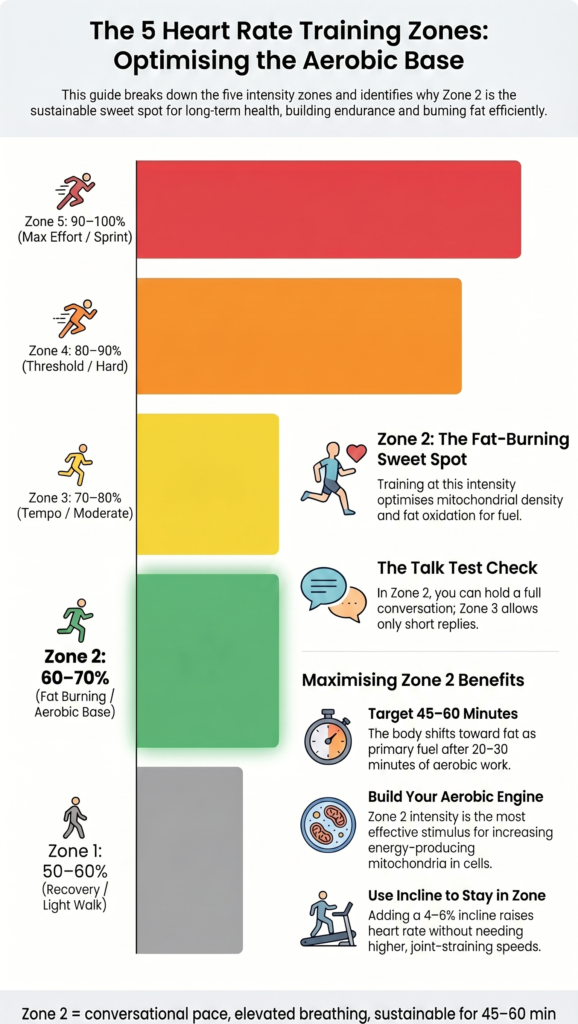
What speed is zone 2 on a walking pad?
For most people, zone 2 walking pad speed falls between 4.5 and 5.5 km/h (2.8–3.4 mph) on a flat surface. But that range shifts meaningfully based on three factors: your age, your fitness level, and your incline setting. A fit 30-year-old may need 5.5–6.5 km/h to push their heart rate into zone 2. A deconditioned 55-year-old may hit it at 4.0 km/h. Someone walking at 6% incline needs a lower speed than someone on a flat surface to reach the same heart rate.This is why generic speed guides are only a starting point. The calculator above accounts for all three variables — use it to get your personalised number, then cross-check it with the talk test during your first session. The talk test is the most reliable real-world check: you should be able to speak in full sentences, but your breathing should be noticeable. If you can sing, you are too slow. If answering in full sentences feels difficult, you have drifted into zone 3.
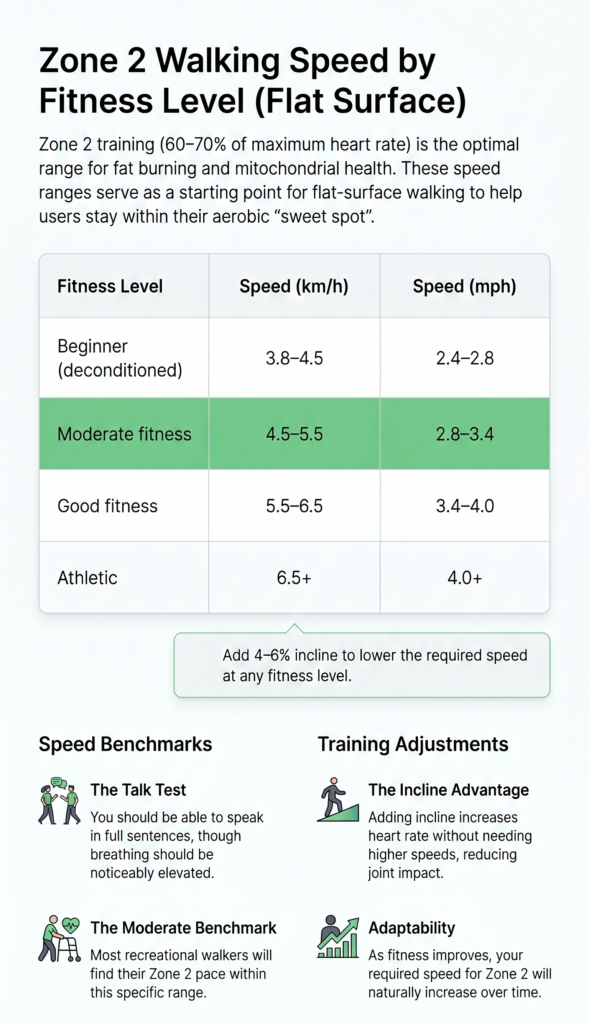
What speed is zone 2 on a treadmill?
On a treadmill with no incline, zone 2 speed follows the same logic as a walking pad — typically 4.5–5.5 km/h (2.8–3.4 mph) for beginners and moderate fitness levels. Treadmills open up more options because of their powered incline. Adding 4–6% incline lets you walk at a slower, more comfortable speed while your heart rate climbs into zone 2 — this is easier on the ankles and Achilles, recruits the glutes and hamstrings more actively, and is particularly useful for anyone returning from a lower limb injury.
The widely shared 12-3-30 protocol — 12% incline, 3 mph, 30 minutes — works for many people as a zone 2 session, though at 12% incline some individuals push into zone 3. Always let your heart rate reading or talk test guide you, not a fixed protocol. The incline table in the calculator above gives you the adjusted speed target for every incline setting from 0 to 12%, so you can find the combination that works for your setup.
The Tanaka formula vs 220 minus age: why it matters
Most online zone calculators use the 220 minus age formula to estimate maximum heart rate. It is simple, but research consistently shows it overestimates max HR in younger adults and underestimates it in older adults. The Tanaka formula — 208 minus 0.7 times age — is derived from a meta-analysis of over 350 studies and is significantly more accurate across age groups, particularly for people over 40. The calculator on this page uses Tanaka combined with the Karvonen method, which also accounts for your resting heart rate. The result is a zone 2 target that reflects your actual cardiovascular state, not just your age.As a practical example: a 50-year-old with a resting heart rate of 60 bpm gets a zone 2 range of roughly 118–130 bpm using the Karvonen/Tanaka method. The basic 220 minus age formula gives a maximum HR of 170, making zone 2 appear to be 102–119 bpm — a significantly lower range that would have that person walking far too slowly to drive meaningful adaptation.
How long does a zone 2 walking session need to be?
The minimum effective zone 2 session is 30 minutes of actual zone 2 time, not including warm-up and cool-down. Research supports 45–60 minutes as the optimal range for fat oxidation and mitochondrial adaptation in most adults. The reason duration matters more in zone 2 than in high-intensity training comes down to fuel use: your body spends the first 20–30 minutes of any aerobic session burning through stored glycogen before it shifts toward fat as the primary fuel source. Sessions under 25 minutes may not reach that switch, which means you get cardiovascular benefit but limited fat-burning and mitochondrial adaptation.For beginners, 30 minutes three times per week is a proven starting point. Build to 45 minutes over four to six weeks. For remote workers using a walking pad under a desk, two 30-minute walking sessions during the work day — one in the morning, one after lunch — easily covers the weekly dose without requiring dedicated workout time.
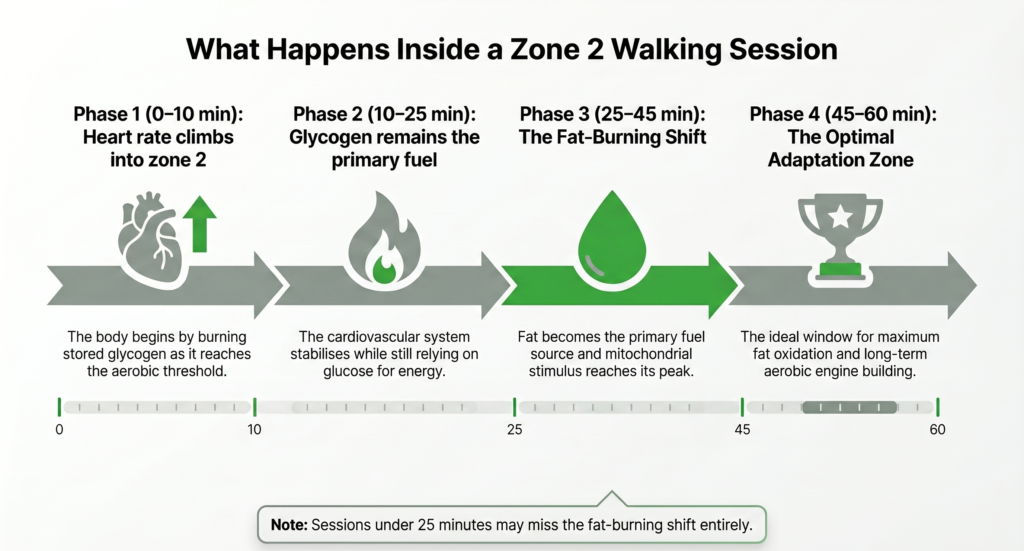
Zone 2 walking and fat burning: what the research actually says
Zone 2 is often called the fat-burning zone, but the label is slightly misleading. At zone 2 intensity, fat provides a higher percentage of total energy than at higher intensities — typically 50–60% of calories from fat at zone 2 versus 30–40% at zone 3 or 4. However, because total calorie burn is lower at zone 2 than at higher intensities, the absolute amount of fat burned per session can be similar or lower than a harder session of the same duration.
To see the real numbers for your specific weight, speed, and session length — and compare walking against running, HIIT, and cycling — use our free Calories Burned Calculator.Where zone 2 wins for fat loss is sustainability and frequency. A 45-minute zone 2 walk is recoverable — you can do it tomorrow and the day after. A hard cardio session leaves many people too fatigued to train again for 24–48 hours. The compound effect of five zone 2 sessions per week versus two hard sessions almost always produces more total weekly calorie and fat burn. It also suppresses appetite less than high-intensity training, making consistent nutrition easier. For most home gym users whose biggest obstacle is consistency, zone 2 is the better long-term fat loss tool.
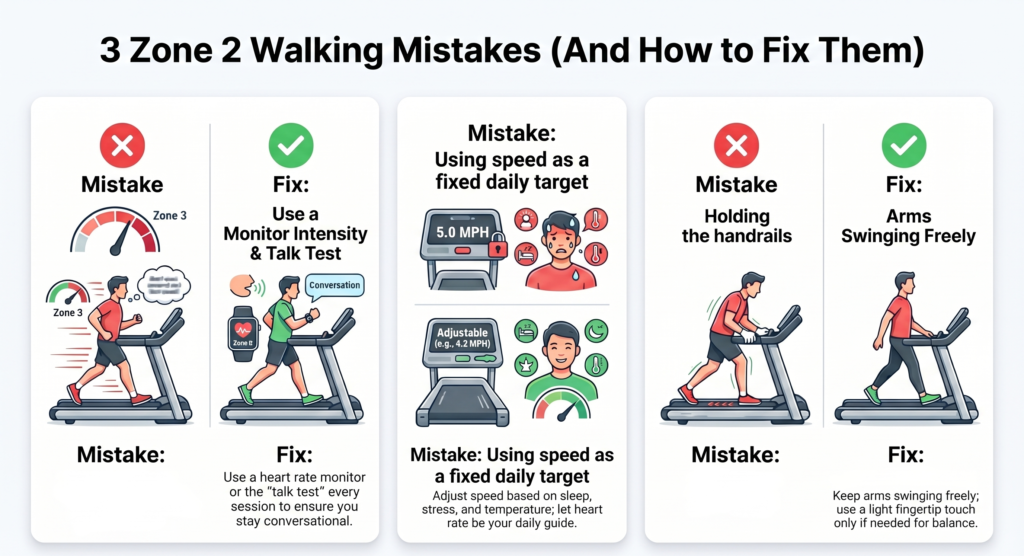
Zone 2 walking mistakes that keep people stuck
The most common mistake is walking too fast. Most people who think they are doing zone 2 are actually in zone 3 — breathing hard enough that conversation is strained, heart rate sitting at 72–80% of maximum. Zone 3 is not useless, but it does not deliver the mitochondrial adaptations of zone 2, it requires more recovery, and it cannot be done daily. If your sessions consistently leave you feeling genuinely tired afterwards, you are almost certainly above zone 2.The second mistake is relying on speed alone. Your zone 2 speed is not a fixed number — it changes with sleep quality, stress, ambient temperature, fatigue, and hydration. On a poor sleep night, what felt like an easy 4.8 km/h yesterday can push you into zone 3 today. Use heart rate as your guide daily, and use speed only as a starting point. A £25 chest strap heart rate monitor paired with a free phone app is the most cost-effective training upgrade any walking pad user can make.The third mistake is holding the rails. On a walking pad or treadmill, gripping the handrails reduces calorie burn by 20–30%, alters your posture, disengages your core, and reduces the cardiovascular demand of the session. Walk with your arms swinging naturally. If balance is a concern, start the belt moving before stepping on, and use a single light fingertip touch rather than a full grip.
How to use incline to hit zone 2 on a slow walking pad
If your walking pad maxes out at 4–4.5 mph and you are fit enough that flat walking does not push you into zone 2, incline is your solution. Each percentage point of incline increases the metabolic demand of walking by roughly 8–10%, which raises your heart rate without requiring higher speed. At 6% incline, most people hit zone 2 at 3.5–4.5 km/h — well within any walking pad's range.Many current walking pad models offer a fixed manual incline of 4–5% by adjusting the front feet. Budget models with this feature include the WalkingPad A1 Pro and DeerRun A1. For fully adjustable motorised incline up to 10–12%, models like the NovaWalk W50 and Urevo Strol are worth considering. The incline table in the calculator above lets you find the precise speed-incline combination that hits your personal zone 2 heart rate target.
Does walking count as zone 2 cardio?
Yes — for most people, brisk walking is the primary way to achieve zone 2 intensity. Walking at 4.5–5.5 km/h pushes the average adult into the 60–70% max heart rate range that defines zone 2. For people who are highly aerobically fit — regular runners, cyclists, or athletes — flat walking may only reach zone 1, requiring incline or a faster pace to enter zone 2. For beginners and most recreational exercisers, brisk walking is zone 2 training.This is one reason why walking pads have become such an effective home gym tool. They provide the precise speed control needed to stay in zone 2 consistently — something that outdoor walking on varied terrain makes harder to manage. A walking pad set to your calculated zone 2 speed gives you a repeatable, measurable aerobic training stimulus every session.
Zone 2 walking vs HIIT: which is better for home gym users?
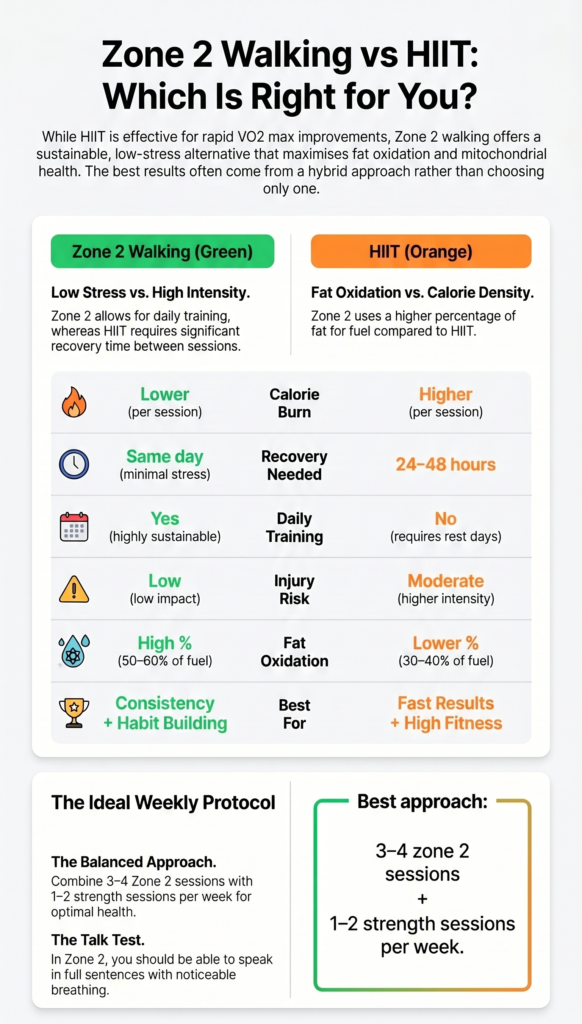
Both have a place, but they serve different purposes and suit different people. HIIT burns more calories per minute, improves VO2 max quickly, and produces visible results fast — but it also raises cortisol, increases appetite, requires recovery days, and carries higher injury risk for beginners. For people who can train consistently at high intensity, HIIT is a powerful tool. For people who are building a habit, managing stress, returning from injury, or training daily while working from home, zone 2 is more practical and often more effective over a full year of training.The most effective approach for most home gym users is a combination: three to four zone 2 sessions per week on a walking pad providing aerobic base and fat oxidation, and one to two strength sessions with dumbbells or bodyweight building muscle and bone density. Japanese walking — the Shinshu University interval walking protocol — offers a middle ground that delivers zone 2 benefits in a 30-minute structured session.
How often should you do zone 2 walking?
Zone 2 training is recoverable enough to be done daily. Unlike HIIT or heavy strength training, which require 24–48 hours of recovery, zone 2 walking generates minimal muscle damage and nervous system stress. Most research on zone 2 frequency recommends three to five sessions per week as the effective dose for meaningful cardiovascular improvement. Elite endurance athletes do zone 2 daily for 60–90 minutes, but for home gym users, 30–45 minutes four times per week is an evidence-based target that produces real results without interfering with strength training or life recovery.
Frequently asked questions
What speed is zone 2 walking for a 40-year-old?
For a moderately fit 40-year-old with a resting heart rate of around 65 bpm, zone 2 typically falls between 60–70% of their maximum heart rate — roughly 107–125 bpm using the Tanaka/Karvonen formula. The walking speed that produces this heart rate on a flat surface is usually 4.8–5.5 km/h (3.0–3.4 mph). With a 4–6% incline, that drops to around 4.0–4.5 km/h. Use the calculator above with your exact details for a precise number.
Why is my heart rate too high when I walk at zone 2 speed?
Several factors raise heart rate beyond what the formula predicts: poor sleep the night before, dehydration, high ambient temperature, elevated stress or caffeine, and the first few weeks of a new exercise routine when your cardiovascular system is still adapting. If your heart rate is consistently higher than your zone 2 target at the recommended speed, slow down by 0.3–0.5 km/h and recheck. Over six to eight weeks of consistent zone 2 training, you will find you can walk faster at the same heart rate as your aerobic fitness improves.
Is 30 minutes of zone 2 walking enough?
Thirty minutes at true zone 2 intensity delivers measurable cardiovascular benefit and is a solid starting point. For fat oxidation and mitochondrial adaptation, 45 minutes is where the research shows more pronounced results — the fat-burning shift accelerates after the first 25–30 minutes of aerobic work. If you are limited to 30 minutes, three to four sessions per week still produces meaningful progress. More total weekly zone 2 time is more effective than any single session length.
What is the difference between zone 2 and zone 3 walking?
Zone 2 (60–70% max HR) is conversational — full sentences, controlled breathing, sustainable for 45–60 minutes. Zone 3 (70–80% max HR) is tempo pace — 3–4 word replies, noticeably elevated breathing, sustainable for 20–40 minutes before fatigue sets in. Zone 3 burns more calories per minute but requires more recovery, produces less fat oxidation per calorie burned, and cannot be done daily. Most people trying to walk in zone 2 accidentally drift into zone 3 within 10–15 minutes — which is why a heart rate monitor or the talk test check matters throughout the session.
Can I do zone 2 walking on a walking pad every day?
Yes. Zone 2 walking generates low enough stress on the muscles, joints, and nervous system to be done daily for most healthy adults. The limiting factor is usually not physical recovery but time and motivation. Five sessions per week is a realistic daily-use target. If you walk under a standing desk during your work day, breaking it into two 30-minute sessions — morning and post-lunch — is an easy way to accumulate the weekly dose without thinking of it as dedicated workout time.
How do I know if I'm actually in zone 2 without a heart rate monitor?
The talk test is the most reliable method without a monitor. Hold a conversation — or speak a sentence out loud if you are walking alone. If you can speak comfortably in full sentences but feel your breathing is noticeably elevated, you are in zone 2. If you can sing without effort, slow down. If answering in three or four words is all you can manage, you are in zone 3 or above. The talk test has been validated against heart rate monitoring in multiple studies and is consistently accurate for identifying the zone 2 to zone 3 threshold.
Does zone 2 walking burn belly fat?
Zone 2 walking burns fat as fuel — more so as a percentage of total energy than higher intensity exercise. However, spot reduction of fat from specific areas is not physiologically possible. Your body draws fat from stores throughout the body based on genetics and hormones, not based on where you feel the exercise. Zone 2 walking reduces overall body fat over time, which includes visceral fat around the abdomen. Research specifically links regular zone 2 cardio to reductions in visceral fat, improved insulin sensitivity, and lower fasting blood glucose — all markers associated with improved metabolic health and reduced abdominal fat accumulation.
What is a good zone 2 heart rate for walking?
Your zone 2 heart rate is personal — it is 60–70% of your maximum heart rate, calculated using the Tanaka formula (208 minus 0.7 times your age) and adjusted for resting heart rate using the Karvonen method. As a rough guide: a 30-year-old typically targets 120–133 bpm; a 45-year-old targets 113–125 bpm; a 60-year-old targets 104–116 bpm. These are estimates. The calculator above gives you a more precise personalised range.
Zone 2 walking is most effective when it is part of a structured training approach. If you want to add interval intensity on top of your zone 2 base, our Japanese walking guide covers the Shinshu University IWT protocol — a 30-minute session that alternates fast and slow intervals and has been shown to increase VO2 max by up to 20% over five months. You can also use our Japanese walking calculator to get personalised calorie and heart rate targets for IWT sessions. And if you are still deciding whether a walking pad or treadmill is the right tool for your home setup, our walking pad vs treadmill guide will give you a clear answer based on your goals, space, and budget.At AnyRoomGym.com, every calculator and guide is built on published research and real-world testing. This zone 2 walking speed calculator uses the Tanaka max HR formula and Karvonen method — the same equations exercise physiologists use in clinical settings. If you found it useful, bookmark it and retake it as your fitness improves — your zone 2 speed will increase over time, and the calculator will keep your targets accurate.