You’ve measured the spare room three times. You’ve stared at the garage wondering if a rack actually fits. You’ve Googled this exact question and gotten either a Reddit thread full of conflicting opinions or a generic article telling you “it depends.”
It does depend. But on specific things — and once you know them, the answer becomes clear in under 60 seconds.
This guide gives you the exact numbers, the common mistakes, and a free interactive calculator that tells you precisely what fits in your space — equipment by equipment, including ceiling height warnings.
The short answer: how much space does a home gym actually need?
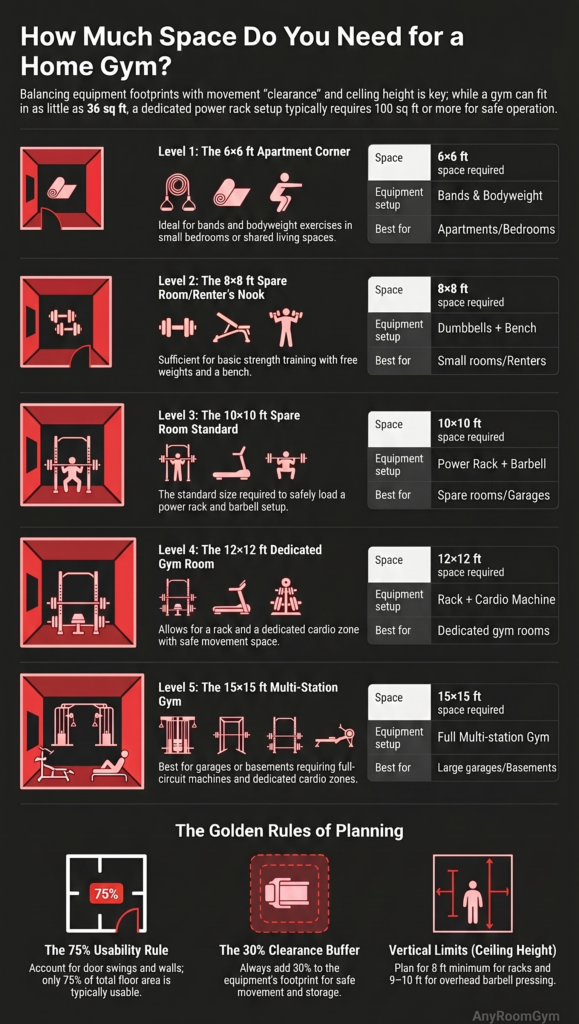
You can build a functional home gym in as little as 6×6 feet (36 sq ft). A practical setup most people are happy with starts at 8×8 feet (64 sq ft). A comfortable gym with a power rack and bench needs around 10×10 feet (100 sq ft) minimum.
But square footage alone doesn’t tell the full story. Here’s the complete breakdown by setup type:
| Setup type | Minimum room size | Best for |
|---|---|---|
| Bodyweight / bands only | 6×6 ft (36 sq ft) | Apartments, bedrooms |
| Dumbbells + bench | 8×8 ft (64 sq ft) | Small rooms, renters |
| Power rack + barbell | 10×10 ft (100 sq ft) | Spare rooms, garages |
| Power rack + cardio | 12×12 ft (144 sq ft) | Dedicated gym rooms |
| Full multi-station gym | 15×15 ft (225+ sq ft) | Garages, basements |
The overlooked factor? Ceiling height. A room can be 200 sq ft and still be unusable for a power rack if the ceiling is 7 feet. We cover this below.
Use the Free Home Gym Space Calculator First
Before reading further, plug in your room dimensions and select the equipment you want. The calculator will instantly tell you:
- Whether your room can handle your equipment wishlist
- How much usable space remains after clearances
- Specific ceiling height warnings for items like power racks and treadmills
- Smarter equipment swaps if you’re over on space
[→ Free Home Gym Space Calculator — AnyRoomGym]
Then come back to this guide for the full breakdown.
Home Gym Space Calculator
Enter your room dimensions and select equipment to see what fits.
Select Equipment
The most common home gym space mistake
Most people do this in the wrong order: they buy equipment, then try to fit it in a room.
The right order is:
- Measure your room (length, width, ceiling height)
- Decide on your training goals
- Pick equipment that matches both your goals and your space
- Confirm everything fits — including clearances
The clearance rule is what catches most people out. You don’t just need space for the equipment footprint. You need space for you to move around it safely. As a general rule, add 30% to your equipment footprint total for clearances, movement space, and storage.
Home gym space requirements by equipment type
Here are the actual space requirements you need to plan around — not manufacturer minimums, but real-world numbers that give you room to train safely.
Strength equipment
Adjustable dumbbells — 4 sq ft on a stand. The single best space-saving strength investment. A pair like Powerblocks replaces an entire dumbbell rack.
Dumbbell rack (full set) — 10–15 sq ft depending on weight range. Wall-mounted racks can cut floor footprint in half.
Adjustable bench — 15 sq ft including the space to sit, load, and adjust. Foldable benches reduce this to 8 sq ft when stored.
Power rack — 35–40 sq ft before clearances. You need at least 3 feet of clearance on each open side for loading a barbell and racking safely. This means a typical power rack setup realistically needs a 10×10 dedicated zone. Ceiling height minimum is 8 feet — more on this below. See our best power rack for home gym guide for compact options that work in tighter rooms.
Squat stand (2-post) — 20 sq ft. More compact than a full rack, but offers less safety for solo training.
Cable machine / functional trainer — 25 sq ft footprint plus 5–6 feet of movement space in front. Total zone: roughly 40–50 sq ft.
Pull-up bar (wall or doorframe mounted) — Near zero floor space. Requires 8 ft ceiling minimum for most people (6ft person + arm extension + jump clearance).
Kettlebells — 6–8 sq ft for a small set. Highly space-efficient for the training variety they offer.
Resistance bands — 4 sq ft when stored. Require 10–12 sq ft of clear floor space to use effectively.
Cardio equipment
Treadmill — 40 sq ft (typically 7×3 ft machine) plus 3 feet of safety clearance behind. Real-world zone: 50–55 sq ft. Also requires 7.5 ft ceiling minimum due to user height while elevated.
Walking pad (under-desk treadmill) — 18 sq ft. The best space-saving cardio option for small rooms. If you’re training Zone 2 cardio, a walking pad is nearly as effective as a full treadmill at a fraction of the footprint. See our guide on Zone 2 walking pad speed to dial in the right pace.
Stationary bike (upright) — 10 sq ft. Most compact powered cardio option.
Rowing machine — 20 sq ft stored, but requires 8–9 feet of clear length when in use. Poor choice for narrow rooms.
Elliptical — 30 sq ft footprint but needs 7.5 ft ceiling height because your head reaches higher than standing during the stride.
Functional and floor training
Yoga / stretch mat — 20 sq ft of clear floor. This space doubles for stretching, core work, mobility, and any floor-based training.
Plyo boxes / jump mat — 12 sq ft for the equipment, but you need 9+ feet of ceiling height for box jumps. The most ceiling-limited piece of equipment after overhead press work.
Ceiling height: the factor most guides ignore
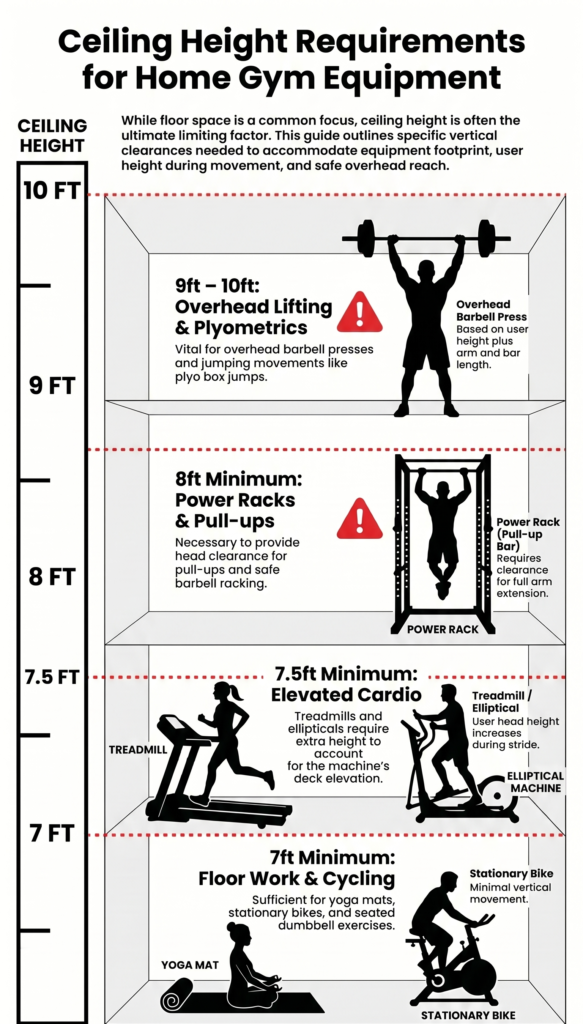
Floor space gets all the attention. Ceiling height is what actually limits your options.
Here are the real minimums — not what manufacturers claim, but what actually lets you train without hitting anything:
| Equipment | Minimum ceiling height |
|---|---|
| Resistance bands, stationary bike, yoga | 7 ft |
| Dumbbell training, bench press | 7 ft |
| Walking pad, treadmill | 7.5 ft (taller users need 8 ft) |
| Power rack (pull-ups) | 8 ft minimum, 9 ft comfortable |
| Overhead barbell press | 9–10 ft (depends on your height) |
| Box jumps, plyo work | 9+ ft |
| Assault bike sprints | 7 ft |
The overhead press rule: if you’re 6 feet tall, your hands reach roughly 8.5 feet overhead with a barbell. Add 6 inches of safe clearance and you need at least 9 feet. Many spare rooms and basements fall short of this.
Basement gyms especially: Beams, ductwork, and pipes reduce your effective ceiling height. Measure to the lowest obstruction, not the ceiling itself.
Space-by-space breakdown: what actually fits
Apartment bedroom or spare room (typical 10×10 to 12×12 ft)
Best setup: Adjustable dumbbells + bench + resistance bands + pull-up bar + yoga mat
This gives you full-body strength training, some cardio, and mobility work in under 80 sq ft of active space. Add a walking pad against one wall for cardio days — it slides under a bed when not in use.
What won’t fit comfortably: A full power rack. The footprint is workable at 10×10, but loading the bar and training safely with good clearances is tight. A squat stand is the better call in this scenario.
Ceiling reality check: Standard US residential ceilings are 8–9 feet. That clears pull-ups and dumbbell work but limits overhead barbell pressing.
Single-car garage (approx. 12×20 ft = 240 sq ft)
This is the sweet spot for most serious home gym builders. A 240 sq ft garage comfortably fits:
- Full power rack with barbell and plates
- Adjustable bench
- Dumbbell rack
- Walking pad or stationary bike
- Full rubber flooring
- Storage for accessories
With room to train comfortably in all of them. Ceiling height in a single-car garage is typically 8–10 feet — enough for pull-ups and most barbell work. If you’re planning overhead barbell press, confirm your specific ceiling height first. Our power rack guide covers compact racks designed for low-ceiling garages.
Living room corner (6×8 ft available)
This works. Contrary to what most people think, a 48 sq ft corner is enough for:
- Adjustable dumbbells on a compact stand
- Foldable bench (stores flat against wall)
- Resistance bands
- Yoga mat (rolled up when not training)
Total training footprint when active: ~35 sq ft. When stored: ~12 sq ft. The entire setup can be invisible when not in use — perfect for renters or anyone sharing a living space.
What to avoid here: Anything that doesn’t fold, store, or stack. A treadmill, power rack, or cable machine in a living room corner will dominate the space permanently and become a permanent source of household friction.
Basement (typically 400–600 sq ft open plan)
The best possible home gym scenario. The main challenge in basements isn’t floor space — it’s ceiling height. Many basements have 7–8 ft ceilings with ductwork and beams that bring this lower in spots.
Map your ceiling before buying anything with a height requirement. A 6 ft 4 in duct running across your planned rack position is the difference between doing pull-ups and not.
The 75% rule: why your room’s total sq ft doesn’t equal your usable sq ft
A 10×10 room is 100 sq ft on paper. But walls, door swing, and access paths mean roughly 75% is actually usable — about 75 sq ft.
This is why equipment that “technically fits” on a floorplan still feels cramped in real life. Always calculate against 75% of your room’s square footage, not the full total.
Our calculator applies this automatically.
Renting? What you can and can’t do to your space
A major concern for renters is what modifications are allowed. Here’s what’s generally acceptable without landlord approval (always check your lease):
Typically fine:
- Rubber flooring tiles (lay on top, no adhesive)
- Freestanding equipment (nothing bolted to walls or floor)
- Doorframe pull-up bars (compression-style, no screws)
- Wall-mounted mirrors using standard picture hooks
Requires landlord permission:
- Drilled pull-up bars or rack anchors
- Wall-mounted storage brackets
- Any structural modification
The good news: you can build a highly effective home gym with zero permanent modifications. Adjustable dumbbells, a foldable bench, resistance bands, a compression pull-up bar, and a walking pad give you a complete training setup with nothing drilled, bolted, or glued.
Is your home gym investment worth the space it takes up?
Before you commit your spare room or garage to a gym, it’s worth running the numbers on whether a home gym actually saves you money. We built a dedicated calculator for this: Is a Home Gym Worth It? Calculate Your Break-Even in 60 Seconds.
The short version: at the average US gym membership cost of $58/month, most home gym setups pay for themselves within 12–24 months.
How to make a small home gym feel bigger
Space is as much about perception and layout as raw square footage. These changes make a genuine difference:
Use vertical space. Wall-mounted plate storage, pegboards for accessories, and vertical dumbbell racks keep the floor clear and the room feeling open.
Mirrors work. A full-length mirror on one wall doubles the perceived depth of the room. It also improves form feedback — an underrated benefit.
Light the room properly. A dim basement or low-watt garage feels 30% smaller than the same space with bright overhead lighting. LED strips along the ceiling perimeter are cheap and transformative.
Keep one wall completely clear. Even in a well-equipped gym, having one open wall you never put anything against preserves the feeling of space and serves as your floor training zone.
Use foldable gear wherever possible. A foldable bench, a wall-mounted folding rack, and a walking pad that tucks under furniture can convert a multi-use room into a gym in 60 seconds — and back again.
Frequently asked questions
What is the minimum space needed for a home gym?
You can train effectively in as little as 6×6 feet (36 sq ft) with the right equipment — adjustable dumbbells, resistance bands, and a yoga mat. For a strength-focused gym with a bench, plan for 8×8 ft. For a power rack setup, you need at least 10×10 ft with an 8 ft ceiling.
Can I set up a home gym in a small apartment?
Yes. The key is choosing space-efficient equipment: adjustable dumbbells instead of a full rack, a foldable bench, resistance bands, and a doorframe pull-up bar. This setup delivers a full-body workout in under 40 sq ft of active floor space, and most of it stores out of sight when not in use.
How much ceiling height do I need for a home gym?
For basic dumbbell and bench training, 7 feet is enough. For a power rack with pull-ups, you need at least 8 feet — preferably 8.5–9 feet for comfortable clearance. Overhead barbell pressing typically requires 9–10 feet depending on your height. Always measure to the lowest obstruction (beams, ductwork), not the ceiling itself.
Does a home gym need rubber flooring?
It’s strongly recommended for any strength setup. Rubber flooring protects your floor, reduces noise transmission, prevents equipment from sliding, and provides better grip. Interlocking rubber tiles are the easiest solution — they require no adhesive and can be taken up if you move.
How much space does a power rack need?
A standard power rack footprint is about 4×4 ft (16 sq ft). But you need at least 3 ft of clearance on each open side to load barbells and train safely. In practice, plan for a dedicated 10×10 zone for a full rack-and-barbell setup. See our best power rack for home gym guide for compact options designed for tighter spaces.
What is the ideal size for a home gym?
The ideal size is entirely personal, but most experienced home gym owners land on 10×12 to 12×15 feet as the sweet spot — enough for a full rack, bench, dumbbells, and one cardio machine without feeling cramped. A 10×10 room is the practical minimum for a “real” gym that includes barbell training.
Can I build a home gym in a bedroom?
Yes. A standard bedroom is typically 10×10 to 12×12 feet, which is enough for a bench, adjustable dumbbells, a pull-up bar, and a yoga mat. If you want a treadmill or full rack in the same room you sleep, the smell of rubber flooring and the visual dominance of equipment may affect your sleep quality — keep that in mind.
How do I calculate how much space I need for home gym equipment?
Add up the footprint (sq ft) of each piece of equipment, then multiply by 1.3 to account for clearance zones. Divide your room’s total sq ft by 0.75 to get usable space. If your equipment total is under your usable space, you’re good. Our free Home Gym Space Calculator does this automatically — just enter your dimensions and select your equipment.
What is the best home gym setup for a small space?
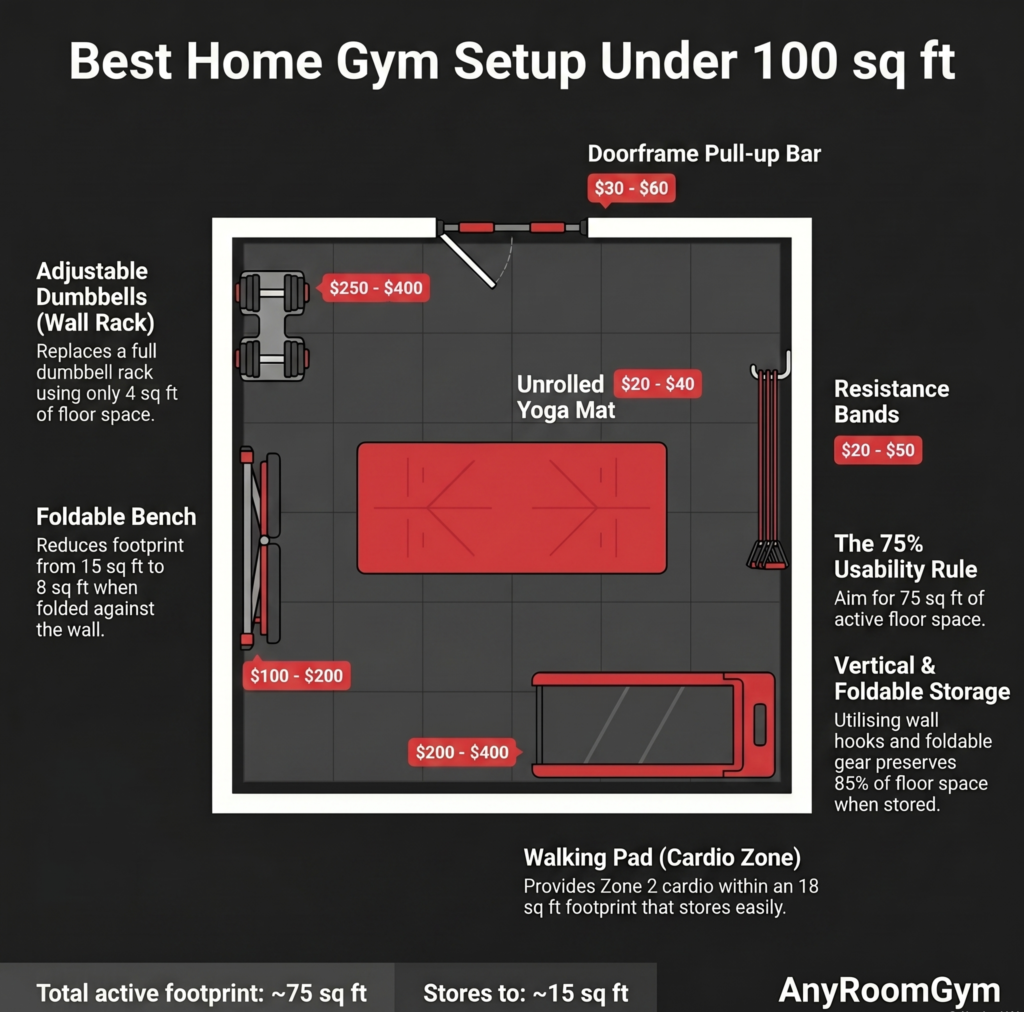
For under 100 sq ft: adjustable dumbbells + foldable bench + resistance bands + doorframe pull-up bar + yoga mat. This setup costs $400–$800, requires no permanent modifications, and gives you a complete push/pull/legs training program. Add a walking pad if you have wall space for cardio — it slides under most beds when stored.
Do I need planning permission for a home gym?
For an indoor home gym using an existing room, no planning permission is needed in the US or UK. If you’re building a garden gym shed or converting a garage with structural changes, local planning rules may apply. Check with your local authority.
The bottom line
You don’t need a commercial gym’s worth of space to train seriously at home. What you need is:
- An honest measurement of your room (length, width, ceiling height)
- A clear picture of your training goals
- Equipment choices that match both
The biggest mistake people make isn’t choosing a room that’s too small — it’s buying the wrong equipment for the room they have. A walking pad and adjustable dumbbells in a 10×10 room will produce better results than a crammed full rack you can barely load.
Use the calculator above to confirm your setup before you spend anything.
And when you’re ready to choose equipment, our best power rack for home gym guide covers the top space-efficient options for every ceiling height and budget.
Table of Contents
Published by AnyRoomGym — home workout guides, space-saving equipment reviews, and free fitness tools. No gym required.