July 29, 2026
No Comments
Quick Answer: You don’t need a reformer, a studio, or even a lot of floor space to start Pilates. This beginner routine uses seven mat based moves, takes about 20 minutes, and needs nothing but a small clear patch of floor about the size of a yoga mat. Follow the full video below or work through the move by move breakdown at your own pace.
I keep coming back to the same thing when I write about small space fitness: the best workout for an apartment is the one that doesn’t need you to own anything. Mat Pilates fits that better than almost anything else I cover on this site. It was originally designed as rehabilitation work, not a studio trend, which is part of why the method leans on concentration through each movement, engagement of the abdomen and low back muscles, and controlled breathing rather than heavy equipment. That’s also exactly the kind of movement quality I pay attention to given my medical training, controlled and deliberate beats fast and momentum driven almost every time when you’re just starting out.
Why Mat Pilates Works for a Small Apartment
You need a footprint roughly the size of one exercise mat, about 6 feet by 2 feet, and enough overhead clearance to lie flat with your arms extended. That’s it. No machine, no fold down storage question, no noise complaints from downstairs since nothing involves impact.
Run your actual room dimensions through my Home Gym Space Calculator if you want to confirm what fits before you commit to a regular practice spot. Most people find they already have the space, they just haven’t measured it.
What You Actually Need
Technically, nothing. You can do this routine on carpet or a folded towel. But a proper mat makes the floor work far more comfortable on your spine and hips, and decent workout clothing keeps you from fighting your own waistband during twists and rolls.
Mat: Wai Lana Yoga mat is a solid beginner pick, extra cushioning without being so thick that it throws off your balance during standing or kneeling moves. [Barefoot Yoga Co] makes a slightly firmer eco-friendly option if you find softer mats unstable. Clothing: prAna activewear holds its shape through spine twists and rolling movements better than looser fabrics, which matters more in Pilates than in most workout styles since so much of the form cueing depends on you being able to see and feel your own alignment.
Before You Start: A Quick Safety Note
Pilates is low impact, but low impact isn’t the same as risk free. Pilates, yoga, and barre are all considered excellent ways to improve posture, strengthen your core, and increase balance and range of motion without putting a lot of stress on your joints, which is exactly why Pilates is such a common starting point for beginners. That said, if you’re pregnant, postpartum, managing a herniated disk, unstable blood pressure, or you haven’t exercised in a long time, check with your doctor before starting, and go slower than the video pace suggests until you know how your body responds.
For more background on what Pilates actually is and how it compares to other low impact options, Cleveland Clinic’s overview and Mayo Clinic’s Pilates vs. yoga vs. barre comparison are both worth a read.
The 7-Move Beginner Routine
Work through these in order. Move slowly, breathe through each rep instead of holding your breath, and stop any move that causes sharp pain, not just muscle fatigue.
1. Cat Cow (Warm Up)
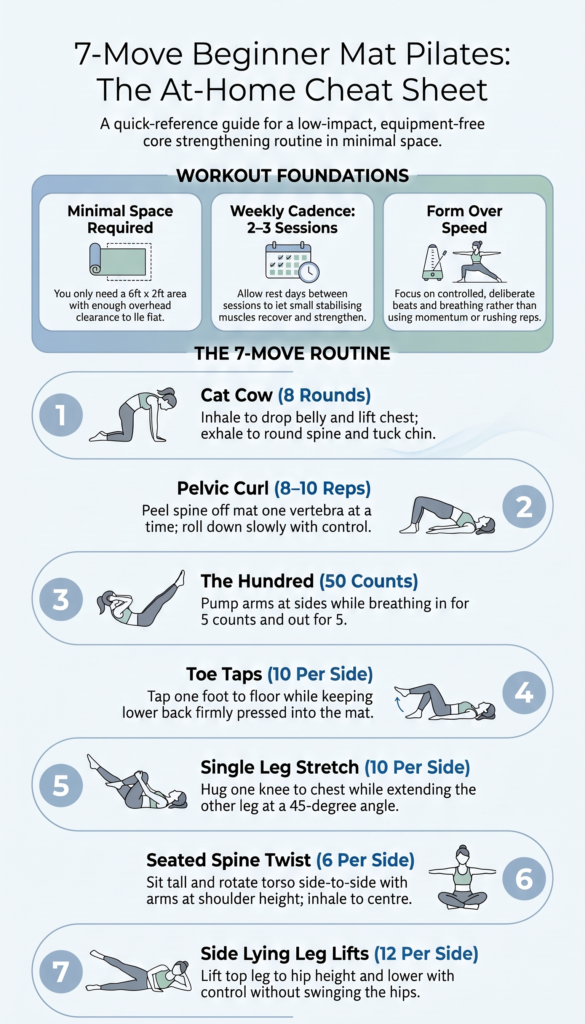
Start on hands and knees, wrists under shoulders, knees under hips. Inhale, drop your belly and lift your chest and tailbone. Exhale, round your spine toward the ceiling and tuck your chin. 8 slow rounds.
2. Pelvic Curl
Lie on your back, knees bent, feet flat hip-width apart. Exhale and peel your spine off the mat one vertebra at a time until your hips are lifted, squeezing your glutes at the top. Inhale at the top, exhale and roll back down slowly, one vertebra at a time. 8 to 10 reps.
3. The Hundred (Beginner Version)
Lie on your back, knees bent at tabletop. If you feel neck strain, keep your head down instead of lifting it. Pump your arms up and down at your sides in small controlled movements. Inhale for 5 counts, exhale for 5 counts. Beginners can stop at 50 counts instead of the full 100.
4. Toe Taps
Lying on your back, knees at tabletop, hands resting by your sides. Slowly lower one foot to tap the floor while keeping your lower back pressed into the mat, then return to start and switch feet. 10 reps per side.
5. Single Leg Stretch
From tabletop, hold one knee into your chest with both hands while extending the other leg out at a 45 degree angle. Switch legs in a slow, controlled pulse. 10 reps per side.
6. Seated Spine Twist
Sit tall with legs extended in front of you, or crossed if that’s more comfortable, arms out to the sides at shoulder height. Exhale and rotate your torso to one side, inhale back to center, exhale to the other side. 6 reps per side.
7. Side Lying Leg Lifts
Lie on your side, legs stacked and slightly forward of your hips, head resting on your extended arm. Lift your top leg to hip height and lower it with control, no swinging. 12 reps per side, then switch sides.
If you’d rather be guided through the whole thing instead of reading move by move, follow along with this 30 minute no equipment routine above. It covers all the same movement patterns with a proper warm up and cool down built in.
How Often Should You Do This as a Beginner
Two to three sessions a week is enough to build real core strength without overtraining while your body is still learning the movement patterns. Give yourself a rest day between sessions early on, mat Pilates works small stabilizing muscles that fatigue differently than the big muscle groups you’d hit in a typical strength workout, and they need the recovery time just as much.
Is It Worth Paying for a Studio Class Instead
Not when you’re starting out. Studio mat classes are useful once you want live form correction, but the movement patterns in this routine are simple enough to learn safely on your own. If you later find yourself wanting more variety or considering a reformer, run the numbers through my Home Gym ROI Calculator first to see what actually makes sense for how often you’d realistically go.
Frequently Asked Questions
Do I need any equipment to start mat Pilates?
No. A mat makes it more comfortable, but you can start on a carpeted floor or a folded towel while you decide if it’s for you.
How is mat Pilates different from reformer Pilates?
Mat Pilates uses your own bodyweight as resistance. Reformer Pilates uses a spring loaded machine that adds resistance through a sliding carriage. Mat work is the better starting point for beginners since it teaches the core engagement and control that reformer work builds on later.
Is Pilates safe if I’ve never worked out before?
Generally yes, since it’s low impact and self-paced. Still, if you’re pregnant, postpartum, managing a back injury, or haven’t been cleared for exercise recently, check with your doctor first and start with fewer reps than the routine suggests.
How long until I notice a difference?
Most beginners notice better posture and less lower back tension within two to three weeks of doing this routine two to three times a week. Visible core definition takes longer and depends on other factors like overall activity level and diet.
Can I do mat Pilates every day?
You can, but it’s not necessary for beginners and it can actually slow your progress if the small stabilizing muscles never get a chance to recover. Two to three sessions a week with rest days between is a better starting cadence.
Which of these seven moves felt hardest for you? I’d genuinely like to know, it usually tells you exactly where your core is weakest.